Body Movement & Styling
Arm Styling Circle
Controlled circular arm pathway through shoulder, elbow, and wrist, phrased musically while keeping the shoulder free.
solo, body
Salsa · movement · body knowledge · musicality
A bilingual reference for Salsa steps, turns, partner figures, Casino, Rueda, shines and body movement. Each entry combines technical description, body knowledge, teaching notes, musical context, and guidance on timing, space and partner communication.
Find movements
Body Movement & Styling
Controlled circular arm pathway through shoulder, elbow, and wrist, phrased musically while keeping the shoulder free.
solo, body
Body Movement & Styling
Segmented body wave initiated by the sternum and upper chest, followed by the ribs and torso and then the pelvis and knees. The segments reach their greatest displacement at different moments, creating a continuous wave rather than a rigid whole-body lean.
solo, body
Body Movement & Styling
Oppositional organization of pelvis and ribcage that dynamically supports turns, walking actions, and partner orientation.
cross-style, body
Body Movement & Styling
Coordinated response of feet, knees, pelvis, and torso to complete weight transfer; hip action emerges from loading rather than isolated pushing.
cross-style, body
Body Movement & Styling
Coordinated gaze-and-head action in turns: the eyes remain on a reference point as long as practical and quickly reacquire it after rotation.
solo, turns
Body Movement & Styling
Deliberate pelvic movement with a comparatively stable ribcage, without obscuring the actual weight distribution through the feet.
solo, body
Body Movement & Styling
Deliberate shift or rotation of the ribcage while keeping the pelvis comparatively quiet, developing differentiated upper-body control and styling.
solo, body
Body Movement & Styling
Single or alternating shoulder action performed independently from larger torso and pelvic movement.
solo, body
Body Movement & Styling
Fast alternating shoulder isolation: one shoulder moves forward while the other moves back, then both reverse. Rib cage, pelvis and feet remain comparatively quiet so the shimmy reads as shoulder action.
solo, body
Body Movement & Styling
Wave-like action primarily through ribcage and spine, with less pelvic involvement than a full body roll.
solo, body
Casino Partner Figures
Closed or near-closed Casino base action with repeated opening and closing of the couple space. In Rueda vocabulary this same base idea is regionally also called Paséala or Aguajea; here Adentro y afuera is treated as an alias-family entry, not as a separate turn figure.
casino
Casino Partner Figures
Alias entry for the same closed-position Casino base action as Adentro y afuera: rhythmic opening and closing of the couple space with elastic weight transfer. Regionally the name does not identify a uniquely different choreography.
casino, rueda
Casino Partner Figures
Bayamo denotes a family of Casino figures with crossed two-hand connection and a Rodeo-Inverso-like circular pathway as a recurring core idea. Entries and exits vary; Sombrero is a possible but not defining resolution.
casino, rueda
Casino Partner Figures
Coca-Cola can denote the Follow’s traveling left turn layered onto a Casino walking/Dile-que-no passage. The rotation is superimposed on continuing travel rather than performed as a stationary spot turn.
casino, rueda
Casino Partner Figures
In common Casino versions, El Dedo combines a guided Follow right turn with Enchufla or a Follow left turn, a Lead right/outward turn, and Dile que no. Starting handhold varies; right-to-right is documented alongside other one-hand variations.
casino, rueda
Casino Partner Figures
Fundamental Casino figure and common transition from closed to open position: the Follow passes the Lead on a curved walking pathway while the Lead opens space, and both finish oriented toward each other again.
casino, rueda
Casino Partner Figures
The name Dile que sí is school-dependent. One couple variant uses a hand-held Vacílala from open position to bring the Follow back into closed or near-closed couple position.
casino, rueda
Casino Partner Figures
Extended Sombrero figure using several successive two-hand and side-changing pathways. One common version begins with Sombrero, moves into a reverse-Sombrero-like return pathway, and then uses further turning and hand pathways before resolving with Dile que no.
casino, rueda
Casino Partner Figures
A Casino shadow figure in which the Lead is in front of the Follow, back toward the Follow, and both walk/pivot in the same general direction before the connection is resolved.
casino, rueda
Casino Partner Figures
Casino shadow figure using aligned or offset partner organization. In one common version the Lead is temporarily behind the Follow while both travel or pivot in a similar direction; other El Uno conventions organize the relative front/back position differently.
casino, rueda
Casino Partner Figures
Compact Casino turn-and-place-change figure in which the follow turns under the hand and the couple re-establishes orientation.
casino, rueda
Casino Partner Figures
Rueda extension of Enchufla: the Follow performs the Enchufla action twice in succession. In the common basic version this is followed by Dame una or the corresponding partner change.
casino, rueda
Casino Partner Figures
A foundational Casino and Rueda figure, most often from closed position: the Follow turns to the right while the Lead opens rotational space and typically organizes the connection through the left hand. Dile que no commonly follows.
casino, rueda
Casino Partner Figures
One Kentucky variant has two clear sections: Enchufla Doble with the left-arm path over/toward the neck, followed by Enchufla with a Lead hook turn and Alarde/arm resolution to the Lead. Other school variants may differ.
casino, rueda
Rueda de Casino
Rueda group figure from the Al Centro/Al Medio formation. Leads and Follows alternately move toward the center; instead of clapping they carry the arms forward/up in the center and lower them outward to the sides while retreating, creating the visual of an opening flower.
casino, rueda
Casino Partner Figures
In a common Casino teaching tradition, Montaña essentially follows the El Dedo pattern with two hand connections: a Follow right turn, Enchufla or Follow left turn, and a following Lead self-turn are organized while both hands remain connected.
casino, rueda
Casino Partner Figures
A common Ochenta y Cuatro form begins in open position with a crossed two-hand connection and a Follow right turn. After the turn, the Lead's right hand is higher and the left hand lower; the rest of the figure develops from this hand organization.
casino, rueda
Casino Partner Figures
Paséala can denote a walking Casino passage: the Follow walks a repeated forward pattern and changes direction at the ends through pivot/walk-around actions. Regionally, “Paséala” is also used for the closed-position Adentro/Aguajea base.
casino
Casino Partner Figures
Rueda/Casino figure in which the Lead circles around the Follow and passes under the joined-arm arch; in Rueda it typically resolves with a change to the next Follow and Dile que no.
casino, rueda
Casino Partner Figures
Extension of Prima: the Prima opening initially remains with the same partner. Hermana then continues: Enchufla is danced with the same partner. In the common Rueda version, the partner change occurs only at the end of this Hermana phase; Dile que no is then completed with the new partner.
casino, rueda
Casino Partner Figures
Widely used Casino sequence with an early wrap or hammerlock organization followed by a resolution through additional turns and passes.
casino, rueda
Casino Partner Figures
One three-eight-count Setenta Complicado variant starts with a Setenta entry into the wrap/hammerlock organization; in the second eight the Lead crosses on count 1 into the characteristic complicated passage and performs the hook turn; the third eight resolves through Enchufla and positioning.
casino, rueda
Casino Partner Figures
The name Setenta Doble is not used consistently across schools. One variant uses two clearly separated Setenta wrap-and-unwind cycles before the final exit.
casino, rueda
Casino Partner Figures
Casino figure using overhead arm pathways that resolve into a characteristic side-by-side finishing position.
casino, rueda
Casino Partner Figures
Free or briefly connected follower turn in which rotational intent is prepared early and then completed without continuous hand guidance.
casino, rueda
Foundations & Timing
A backward weight transfer followed by a forward reversal, keeping the body center controlled rather than drifting excessively away from the base.
cross-style
Foundations & Timing
Six weight changes across eight counts with directional breaks on 1 and 5; counts 4 and 8 carry no regular step.
linear, on1
Foundations & Timing
New York/Eddie Torres On2 basic with six regular weight changes on 1-2-3 and 5-6-7. Directional breaks occur on 2 and 6; counts 4 and 8 carry no regular step. Other On2 traditions use different step placements; this page explicitly describes the ET2/NY organization.
linear, on2
Foundations & Timing
Foundational Cuban Casino organization using elastic weight changes, natural rotation, and circular spatial orientation rather than a strict linear slot.
casino
Foundations & Timing
A basic organized around counter-time emphasis, placing directional changes so the movement responds more strongly to the offbeat structure.
on2, casino
Foundations & Timing
Alternating backward break with a slight lateral opening, commonly used as a relaxed basic variation in social salsa.
cross-style
Foundations & Timing
A forward weight transfer followed by a clear reversal back toward the base position; the break is the functional change-of-direction point.
cross-style
Foundations & Timing
Open-position Casino basic in which both dancers alternately move away from and back toward one another while maintaining an elastic hand connection.
casino, rueda
Foundations & Timing
Salsa rhythm marked almost in place to train timing, foot pressure, and body movement without substantial travel.
cross-style
Foundations & Timing
A deliberate no-step count while body rhythm, breath, and musical tension continue.
cross-style
Foundations & Timing
Salsa basic rhythm executed with lateral weight changes, developing width, hip response, and side-to-side spatial awareness.
cross-style
Foundations & Timing
An added or anticipated weight transfer between primary counts, increasing rhythmic density within the regular salsa pulse.
cross-style
Foundations & Timing
An unweighted floor touch used as a rhythmic addition, embellishment, or preparation for a subsequent weight transfer.
cross-style
Foundations & Timing
Continuous walking steps within salsa timing, keeping each weight transfer distinct while shaping a deliberate pathway through space.
cross-style
Foundations & Timing
A complete transfer of body weight from one foot to the other, forming the technical basis of nearly every salsa step sequence.
cross-style
Linear Partnerwork
A turn whose rotation is briefly checked or redirected through clear lead information before continuing or resolving.
linear, on1, on2
Linear Partnerwork
Linear figure that redirects or checks the follow's forward travel before returning them to the pathway.
linear, on1, on2
Linear Partnerwork
A copa structure resolved into an inward follower turn.
linear, on1, on2
Linear Partnerwork
A copa structure resolved into an outward follower turn.
linear, on1, on2
Linear Partnerwork
Advanced linear passage in which the shared orientation is rebuilt through a larger circular rotation while the follow continues to travel through the lane.
linear, on1, on2
Linear Partnerwork
The lead opens the pathway and guides the follow through the slot to the opposite side; both finish reoriented toward one another.
linear, on1, on2
Linear Partnerwork
A cross body lead in which the follow performs an inside rotation while traveling and then returns to the shared line.
linear, on1, on2
Linear Partnerwork
A cross body lead with an outward follower turn during the pass, maintaining the linear travel pathway.
linear, on1, on2
Linear Partnerwork
The follow turns left from a prepared axis and completes the action with clearly settled weight on the intended foot.
linear, on1, on2
Linear Partnerwork
The follow executes a right turn from a clear preparation and finishes with controlled re-establishment of the axis.
linear, on1, on2
Linear Partnerwork
Arm pathway in which a connected hand is guided over one's own or the partner's head and then released into a relaxed position.
linear, cross-style
Linear Partnerwork
Hand-and-arm position in which a forearm is guided behind the follow's back; the shoulder remains free and the range is kept limited.
linear, casino
Linear Partnerwork
A brief release or redirection of hand connection used to prepare a new hand position without throwing or pulling the partner.
linear, on1, on2
Linear Partnerwork
A follower turn toward the inside of the shared pathway, typically initiated from a linear pass or cross-body structure.
linear, on1, on2
Linear Partnerwork
The lead rotates left, keeping rotational impulse small enough to preserve timing and partner relationship without over-turning.
linear, on1, on2
Linear Partnerwork
The lead rotates to the right within salsa timing, coordinating foot placement, spotting, and connection so partner communication remains available.
linear, on1, on2
Linear Partnerwork
Guided left turn beneath a raised hand connection with a clear rotational pathway and uncompressed shoulder organization.
linear, on1, on2
Linear Partnerwork
Both partners create temporary distance through a controlled break while preserving elastic connection through the hands.
linear, cross-style
Linear Partnerwork
A follower turn toward the outside of the shared pathway, with the lead providing a free and readable rotational track.
linear, on1, on2
Linear Partnerwork
A cross-body structure using the opposite opening or passing direction from the common basic form.
linear, on1, on2
Linear Partnerwork
Guided right turn beneath a raised hand connection; the arm creates space for rotation without pulling on the head or arm.
linear, on1, on2
Linear Partnerwork
A turn combined with travel, using the steps to continuously move the rotational axis through space.
linear, on1, on2
Linear Partnerwork
Controlled release from a wrap position through opening of the arms and an appropriate counter-rotation or continuation of the follow.
linear, cross-style
Linear Partnerwork
Partner passage in which the follow walks through an opened pathway and the connection is then reorganized.
linear, on1, on2
Linear Partnerwork
Partner position in which the follow is guided into a compact wrapped position beside or in front of the lead without locking shoulder or elbow.
linear, cross-style
Rueda de Casino
One Rueda variant of Adiós begins with a back-spot/circular rotation; near the end the Lead ducks under the Follow’s left arm and leaves the current partner to take the next Follow counter-clockwise.
rueda
Rueda de Casino
Adiós con la Hermana or Prima con la Hermana begins without an immediate partner change. After the Adiós/Prima opening, Hermana continues as an Enchufla organization with the current Follow; in the common Rueda version the partner change occurs at the end of Hermana, followed by Dile que no.
rueda
Rueda de Casino
One Cero sequence begins with Enchufla: on 5 the Lead steps back, on 6 into the circle and claps on 7. He then spins back out. The Follow duplicates the inward action next, stepping back on 1, into the circle on 2 and clapping on 3. Both return to the same partner and finish with Dile que no.
rueda
Rueda de Casino
Rueda partner change: each Lead leaves the current Follow and travels downstream to the immediately next Follow; Follows largely hold their circle sectors and receive the incoming Lead. Continue with Dile que no or the next call.
rueda
Rueda de Casino
Rueda partner change by two Follow positions: each Lead skips the immediately next Follow and travels to the second Follow downstream. Follows remain sector-local; the Lead must visibly traverse two slots.
rueda
Rueda de Casino
Immediate repetition of Dame: the Lead who has just arrived releases the new connection again and advances one more Follow slot in the same downstream direction.
rueda
Rueda de Casino
Dame to the next Follow with two claps. In one A-tiempo variant the claps fall on 7 and 8 before Dile que no; other schools place the accents differently.
rueda
Rueda de Casino
Dame to the next Follow with one clap on 7 before the following Dile que no. Partner-transfer mechanics remain identical to Dame.
rueda
Rueda de Casino
Enchufla enters the Al Centro/Al Medio formation. After the Enchufla the roles orient toward the circle center; Leads and Follows then alternate stepping in and back out instead of completing a normal partner-change exit.
rueda
Rueda de Casino
In the compound call Enchufla y Dame, Enchufla is danced with the current partner and is followed by exactly one Dame partner transfer to the next Follow. This avoids a double transfer even though in some Rueda schools “Enchufla” alone already implies a Dame exit.
rueda
Rueda de Casino
Festival de Enchufla can be danced as Enchufla con una, then Enchufla con dos, then Enchufla con tres. The number denotes the escalating clap/accent count; the Enchufla partner-transfer convention remains consistent between repetitions.
rueda
Rueda de Casino
Rueda look-call: while the current base pattern continues, dancers deliberately direct their gaze toward the neighboring “vecina”. Without an added call there is neither a partner change nor a large traveling action.
rueda
Rueda de Casino
In one Ocho sequence, after Enchufla each Lead first walks in front of the first/current Follow, then reaches the Follow to the right/downstream, passes around her back and then in front of her. He then returns to the original partner, passing around her back on the way, and finishes with Dile que no. Follows make local forward/back steps as the Lead passes behind or in front.
rueda
Rueda de Casino
Like Pelota una, but with two claps during the transfer to the next Follow. In one A-tiempo execution the two accents fall on 7 and 8.
rueda
Rueda de Casino
Enchufla with partner transfer to the next Follow; before the Lead reaches the next Follow he claps once on 7, then connects to the new Follow.
rueda
Shines & Footwork
Solo step in which one foot crosses behind the other, creating a compact preparation for direction change or turn.
solo, shines
Shines & Footwork
Relaxed groove-oriented solo step with pronounced knee, hip, and upper-body response to the musical pulse.
solo, shines
Shines & Footwork
Solo step in which one foot crosses in front of the other, preparing a new lateral or diagonal direction.
solo, shines
Shines & Footwork
Lateral sequence of side step, cross, and side step that travels continuously through space.
solo, shines
Shines & Footwork
Footwork pattern combining heel and toe contacts rhythmically while keeping body weight controlled over the base.
solo, shines
Shines & Footwork
Cross step behind or in front of the standing leg followed by a weight transfer, often used to connect shines or turns.
solo, shines
Shines & Footwork
Three-part action of kick, brief ball-of-foot weight transfer, and change to the other foot, often used syncopated.
solo, shines
Shines & Footwork
Forward or backward break with a clear return to the original foot, used as a rhythmic solo element in salsa.
solo, shines
Shines & Footwork
Rhythmically elastic solo step with a characteristic forward-and-back play of the feet and body weight.
solo, shines
Shines & Footwork
Side-oriented solo step using deliberate weight transfer and a delayed hip response.
solo, shines
Shines & Footwork
Gliding step variation in which one foot visually tracks the floor while weight transfers in a controlled way to the supporting foot.
solo, shines
Shines & Footwork
Crossing solo-footwork element in which one foot crosses in front of the other and heel-toe orientation supports the rhythmic direction change.
solo, shines
Shines & Footwork
Crossing step sequence using added subdivisions to create a denser rhythmic texture.
solo, shines
Shines & Footwork
Reversed footwork pattern using toe and heel contacts, often used as a variation or counter-phrase to heel-toe.
solo, shines
Shines & Footwork
Suzy Q variation with clear lateral or diagonal travel rather than an almost stationary execution.
solo, shines
Turns & Spins
Two rapid rotations around the body's axis using compact organization, precise preparation, and controlled exit.
linear, solo
Turns & Spins
Free follower rotation after a clear release impulse, with independent axis control until reconnection.
linear, on1, on2
Turns & Spins
Free rotation without continuous hand connection; preparation and exit therefore rely entirely on one's own axis and timing.
linear, solo
Turns & Spins
Rotation of approximately 360 degrees organized through preparation, rotation, and controlled arrival on the intended standing foot.
cross-style, solo
Turns & Spins
Rotation of approximately 180 degrees with clear weight transfer and stable final orientation.
cross-style, solo
Turns & Spins
Turn in which one foot crosses behind or in front of the base and the crossed position is used to continue rotation.
cross-style, solo
Turns & Spins
Two inward follower rotations, usually initiated from a clearly prepared linear lead.
linear, on1, on2
Turns & Spins
Two self-rotations by the lead within partnerwork while preserving rhythm and the connection needed for the next action.
linear, on1, on2
Turns & Spins
Left turn performed mostly on the spot with compact stepping, organized axis, and controlled finish.
cross-style, solo
Turns & Spins
Two outward follower rotations with a controlled hand pathway and early stabilization of the exit.
linear, on1, on2
Turns & Spins
Turn using one or more pivot actions in which body orientation is redirected over weighted feet.
cross-style, solo
Turns & Spins
Right turn performed mostly on the spot, using a compact foot base and head spotting to support spatial orientation.
cross-style, solo
Turns & Spins
Preparatory counter-action or weight organization that creates rotational potential for a subsequent spin without losing the axis early.
linear, solo
Turns & Spins
Multiple or sustained rotation combined with a clear forward or lateral pathway through space.
linear, solo
Turns & Spins
Deliberate deceleration of a turn and redirection of rotational momentum into a stable exit or follow-up figure.
linear, cross-style
Additional professional background
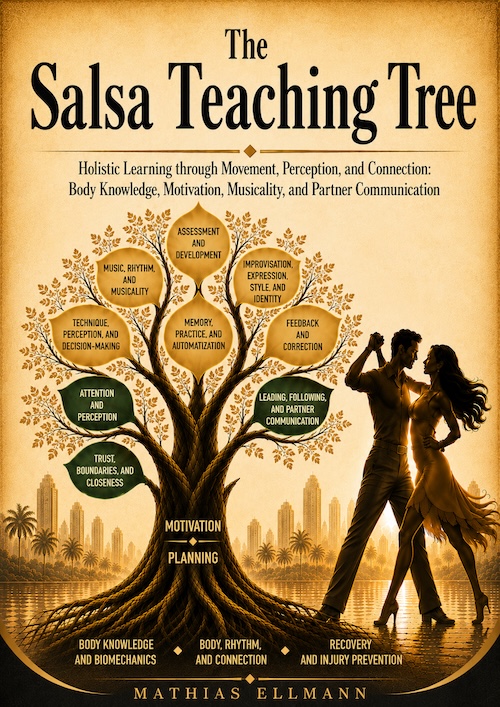
Holistic salsa learning through body knowledge, motivation, perception, musicality and partner communication.
View bookConcept · Salsa knowledge · learning

The lexicon links movement technique with body knowledge, musicality, learning and partner communication.