Rueda Group Figure
01 · Term and function
What is Festival de Enchufla?
Festival de Enchufla can be danced as Enchufla con una, then Enchufla con dos, then Enchufla con tres. The number denotes the escalating clap/accent count; the Enchufla partner-transfer convention remains consistent between repetitions.
a-tiempo, contratiempo
Lead, Follow
a tiempo · contratiempo
02 · Positions, timing and variants
Starting point, direction and variants
Timing, role context and spatial orientation are described separately. Names and execution details can vary across salsa styles, schools and regions.
Enchufla festival
Rueda de Casino
rueda
a-tiempo, contratiempo
Note: Naming and exact sequencing may vary by region or school. This entry describes a widely encountered core idea and does not claim a worldwide rueda standard.
03 · Technical execution
What matters in Festival de Enchufla
The Festival de Enchufla form described here consists of Enchufla con una, followed by con dos and then con tres.
Across the repetitions, the Enchufla or partner-transfer mechanism remains consistent; what changes is the number of clap/accent actions.
The first stage uses one clap or accent within the locally used Enchufla convention.
The following repetitions increase to two and three consecutive accents. The added accents should not interrupt the partner-transfer pathway.
All couples need to recognize and perform the same stage together so partner changes, accents, and rueda spacing remain synchronized as the sequence escalates.
04 · Body knowledge
Body organization in Festival de Enchufla
Festival de Enchufla refers to a series of Enchufla-related calls or variations performed consecutively without a long break. The exact collection can vary between rueda traditions.
Despite the continuous sequence, rotation, weight transfer, and any partner change of each component are sufficiently completed before the next variation begins.
A festival works only when all couples recognize and execute the called variations together. Racing ahead creates gaps and conflicting partner pathways.
05 · For beginners
Build Festival de Enchufla clearly first
Begin with a short sequence of two familiar Enchufla calls.
After each variation, mentally identify which partner, hand connection, and supporting side are now present.
Can you extend the sequence without speeding up or anticipating an unknown next variation?
06 · Teaching and feedback
What to observe in a controlled Festival de Enchufla
The festival reads as a chain of clear Enchufla tasks rather than one uninterrupted multiple rotation.
When a variation includes a change, it occurs across the rueda at the appropriate moment.
The actual order follows the caller or local rueda convention rather than being presented as one universally fixed sequence.
07 · Continue learning
From Festival de Enchufla to related movements
Enchufla enters the Al Centro/Al Medio formation. After the Enchufla the roles orient toward the circle center; Leads and Follows then alternate stepping in and back out instead of completing a normal partner-change exit.
In the compound call Enchufla y Dame, Enchufla is danced with the current partner and is followed by exactly one Dame partner transfer to the next Follow. This avoids a double transfer even though in some Rueda schools “Enchufla” alone already implies a Dame exit.
One Rueda variant of Adiós begins with a back-spot/circular rotation; near the end the Lead ducks under the Follow’s left arm and leaves the current partner to take the next Follow counter-clockwise.
Adiós con la Hermana or Prima con la Hermana begins without an immediate partner change. After the Adiós/Prima opening, Hermana continues as an Enchufla organization with the current Follow; in the common Rueda version the partner change occurs at the end of Hermana, followed by Dile que no.
One Cero sequence begins with Enchufla: on 5 the Lead steps back, on 6 into the circle and claps on 7. He then spins back out. The Follow duplicates the inward action next, stepping back on 1, into the circle on 2 and clapping on 3. Both return to the same partner and finish with Dile que no.
Rueda partner change: each Lead leaves the current Follow and travels downstream to the immediately next Follow; Follows largely hold their circle sectors and receive the incoming Lead. Continue with Dile que no or the next call.
Rueda partner change by two Follow positions: each Lead skips the immediately next Follow and travels to the second Follow downstream. Follows remain sector-local; the Lead must visibly traverse two slots.
Immediate repetition of Dame: the Lead who has just arrived releases the new connection again and advances one more Follow slot in the same downstream direction.
Dame to the next Follow with two claps. In one A-tiempo variant the claps fall on 7 and 8 before Dile que no; other schools place the accents differently.
Additional professional background
Book on learning, body knowledge and partner communication
The movement lexicon complements The Salsa Teaching Tree by Mathias Ellmann. The book connects movement, perception and partner communication with body knowledge, motivation, musicality and sustainable learning.
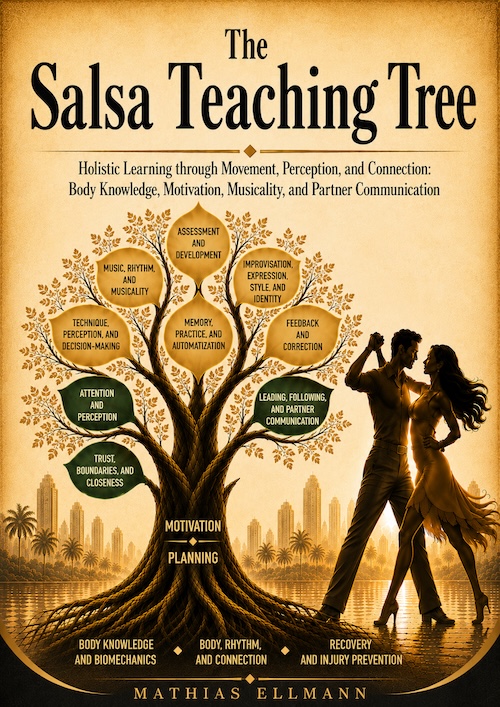
The Salsa Teaching Tree
A holistic orientation model for salsa learning and teaching that goes beyond collecting steps and figures and connects body organization, music, perception, decision-making and partner communication.
View The Salsa Teaching TreeConcept · Salsa knowledge · learning · partner communication
Mathias Ellmann

Mathias Ellmann develops the Salsa Movement Lexicon as a connection between dance technique, body knowledge, musicality, learning and partner communication.
Movement is not considered only in terms of which steps or figures are danced, but also how weight, timing, space, perception and connection interact.
Leading and following are treated as reciprocal communication: one person prepares movement possibilities and makes them perceptible, while the other responds through self-organized movement. Both roles remain perceptive, adaptive and autonomous.