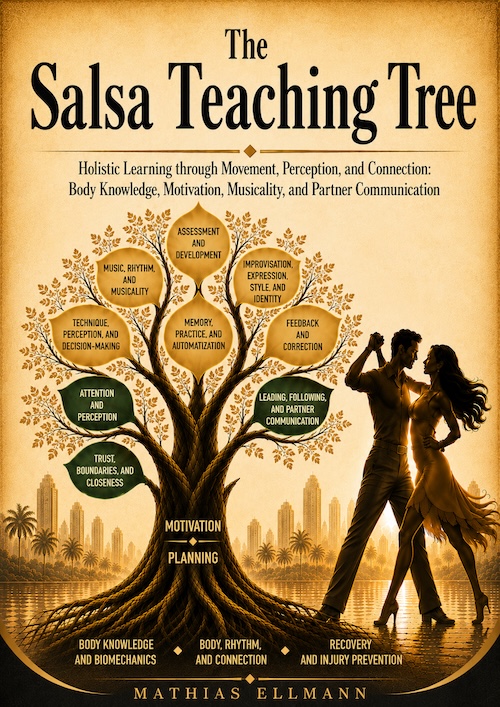
A Book About Holistic Learning and Teaching in Salsa
Salsa is often taught through steps, figures, turns, and counts. Yet sustainable salsa learning involves much more than correctly executing movement sequences. Body organization, music, perception, decision-making, space, and partner communication continuously interact.
The Salsa Teaching Tree presents a holistic orientation model for conscious, adaptable, and sustainable salsa learning and teaching.
Central themes include planning and motivation, body knowledge and biomechanics, recovery and injury prevention, attention and perception, memory, practice and automatization, feedback and correction, music, rhythm and musicality, technique, perception and decision-making, improvisation, expression, style and identity, as well as leading, following, partner communication, trust, boundaries, and closeness.
Target Audience
This book is intended for salsa learners at all levels of experience, salsa dancers, salsa teachers, dance educators, dance schools, independent learners, and anyone who wishes to understand salsa as a physical, musical, and interpersonal path of learning.
Buy the Book
The book is available as an eBook. The available purchase links are listed here.
| ISBN | 978-3-6952-6370-7 |
|---|---|
| Format | eBook |
Topics and Key Themes
Salsa as a Holistic Learning Process
Why salsa is more than steps and figures and simultaneously involves motor learning, musical learning, perceptual learning, and social learning.
Planning and Motivation
How objectives, learning steps, forms of practice, motivation, frustration, uncertainty, and self-overload can be integrated into a sustainable learning process.
Body Knowledge, Biomechanics, and Recovery
How weight transfer, balance, body organization, physical load, recovery, and injury prevention support functional and sustainable dancing.
Perception, Memory, Practice, and Feedback
How attention, perception, practice, automatization, feedback, and correction make movements increasingly available, adaptable, and transferable.
Music, Technique, and Expression
How rhythm, musicality, technique, perception, decision-making, improvisation, expression, style, and identity interact in social dancing.
Leading, Following, and Partner Communication
How shared movement can be understood as reciprocal communication and how trust, boundaries, closeness, consent, and self-determination shape partner dancing.
Frequently Asked Questions
What is “The Salsa Teaching Tree” about?
The book shows how salsa can be understood and developed as a physical, musical, perceptual, and interpersonal learning process. It connects body knowledge, planning, motivation, perception, memory, musicality, technique, partner communication, trust, boundaries, and sustainable development.
Who is the book intended for?
The book is intended for salsa learners at all levels of experience, salsa dancers, salsa teachers, dance educators, dance schools, independent learners, and anyone who wants to understand salsa as a physical, musical, and interpersonal path of learning.
What does the Salsa Teaching Tree mean?
The Salsa Teaching Tree is an orientation model. Its roots represent physical foundations such as body knowledge, biomechanics, physical organization of rhythm, and recovery. The trunk connects planning and motivation. The branches represent attention, perception, memory, practice, automatization, and feedback. Music, musicality, technique, decision-making, improvisation, expression, style, and identity become visible in the leaves. Partner connection includes leading, following, partner communication, trust, boundaries, and closeness. Assessment and continued development form the summit.
Why does salsa require its own teaching model?
Salsa is partner-based, music-responsive, frequently improvised, and shaped by continuous decisions about body organization, space, music, movement, and partner responses. A collection of steps and figures alone therefore cannot explain sustainable salsa learning.
What role do body knowledge and biomechanics play?
Body knowledge and biomechanics help dancers understand weight transfer, balance, body organization, force transmission, movement completion, and partner contact. The aim is not to prescribe one ideal movement form, but to support perception and functional movement decisions.
What role do music and musicality play?
Music and musicality are central parts of salsa learning. Pulse, rhythm, clave relationships, instrumentation, phrases, accents, and pauses provide different forms of temporal and expressive orientation. Musical perception influences movement, technique, dynamics, timing, and decision-making.
How does the book understand leading and following?
Leading and following are understood as reciprocal communication. The leading person prepares a possibility for movement and makes it perceptible. The following person processes that information and responds through a self-organized movement. Both roles remain perceptive, adaptive, and autonomous.
What role do trust, boundaries, and closeness play?
Salsa combines social interaction with physical closeness. Trust, personal boundaries, voluntariness, consent, and self-determination are therefore treated as essential parts of responsible partner communication. Consent to a dance does not constitute unrestricted consent to every touch, figure, or form of closeness.
Is the book only about technique and figures?
No. Technique and figures are important, but they are placed within a broader framework that also includes body knowledge, motivation, perception, memory, practice, feedback, musicality, decision-making, improvisation, partner communication, recovery, and assessment.
Is the book suitable for workshops and lectures?
Yes. The content can be used for workshops, lectures, and practical formats on salsa learning, body knowledge, musicality, practice planning, motivation, feedback, leading and following, partner communication, trust, boundaries, and responsible partner dancing.
Workshops and Lectures on The Salsa Teaching Tree
The content of the book can be presented as a lecture, workshop, or moderated practical format for dance schools, salsa teachers, dance educators, learning groups, associations, educational organizations, and other dance contexts.
Possible areas of focus include body knowledge, motivation, learning and practice planning, perception, musicality, feedback, leading and following, partner communication, trust, boundaries, and sustainable salsa learning.