Rueda Group Figure
01 · Term and function
What is Dame?
Rueda partner change: each Lead leaves the current Follow and travels downstream to the immediately next Follow; Follows largely hold their circle sectors and receive the incoming Lead. Continue with Dile que no or the next call.
a-tiempo, contratiempo
Lead, Follow
a tiempo · contratiempo
02 · Positions, timing and variants
Starting point, direction and variants
Timing, role context and spatial orientation are described separately. Names and execution details can vary across salsa styles, schools and regions.
Dame una
Rueda de Casino
rueda
a-tiempo, contratiempo
Note: Naming and exact sequencing may vary by region or school. This entry describes a widely encountered core idea and does not claim a worldwide rueda standard.
03 · Technical execution
What matters in Dame
In Dame, each Lead clearly leaves the current Follow. The existing connection ends before the next connection is established.
The Lead travels in the downstream direction used by that rueda to the immediately next Follow.
Follows largely retain their circle sectors rather than traveling through the same partner-change pathway as the Leads.
The arriving Lead receives the next Follow with sufficient spacing and clear orientation; the change should work without crossing neighboring travel paths.
Dile que no or the next call follows the partner transfer. The change therefore ends in a clearly usable couple organization.
04 · Body knowledge
Body organization in Dame
In Rueda, Dame organizes a change to the next intended partner. The spatial pathway comes from each dancer's own steps rather than pulling through the previous connection.
In common basic forms, the change is connected with a Dile-Que-No-like reorientation. The important point is that the exit toward the new partner is already prepared through the body pathway.
The call works only when all couples execute the same position logic at the same time. Personal variations must not block neighboring pathways.
05 · For beginners
Build Dame clearly first
Practice one simple Dame change slowly without additional claps, turns, or modifiers.
During the change, find the dancer with whom the next connection will be made before arriving late at the new position.
Does each dancer reach the intended next position through personal steps without pulling either the previous or new partner?
06 · Teaching and feedback
What to observe in a controlled Dame
Couples leave their previous positions in shared timing without creating staggered gaps in the rueda.
The change follows the agreed circle logic rather than unnecessarily crossing neighboring dancers' paths.
The new contact is offered and received without grabbing for the next dancer or catching the body through the hand.
07 · Continue learning
From Dame to related movements
Rueda partner change by two Follow positions: each Lead skips the immediately next Follow and travels to the second Follow downstream. Follows remain sector-local; the Lead must visibly traverse two slots.
Immediate repetition of Dame: the Lead who has just arrived releases the new connection again and advances one more Follow slot in the same downstream direction.
Dame to the next Follow with two claps. In one A-tiempo variant the claps fall on 7 and 8 before Dile que no; other schools place the accents differently.
Dame to the next Follow with one clap on 7 before the following Dile que no. Partner-transfer mechanics remain identical to Dame.
In the compound call Enchufla y Dame, Enchufla is danced with the current partner and is followed by exactly one Dame partner transfer to the next Follow. This avoids a double transfer even though in some Rueda schools “Enchufla” alone already implies a Dame exit.
One Rueda variant of Adiós begins with a back-spot/circular rotation; near the end the Lead ducks under the Follow’s left arm and leaves the current partner to take the next Follow counter-clockwise.
Adiós con la Hermana or Prima con la Hermana begins without an immediate partner change. After the Adiós/Prima opening, Hermana continues as an Enchufla organization with the current Follow; in the common Rueda version the partner change occurs at the end of Hermana, followed by Dile que no.
One Cero sequence begins with Enchufla: on 5 the Lead steps back, on 6 into the circle and claps on 7. He then spins back out. The Follow duplicates the inward action next, stepping back on 1, into the circle on 2 and clapping on 3. Both return to the same partner and finish with Dile que no.
Enchufla enters the Al Centro/Al Medio formation. After the Enchufla the roles orient toward the circle center; Leads and Follows then alternate stepping in and back out instead of completing a normal partner-change exit.
Additional professional background
Book on learning, body knowledge and partner communication
The movement lexicon complements The Salsa Teaching Tree by Mathias Ellmann. The book connects movement, perception and partner communication with body knowledge, motivation, musicality and sustainable learning.
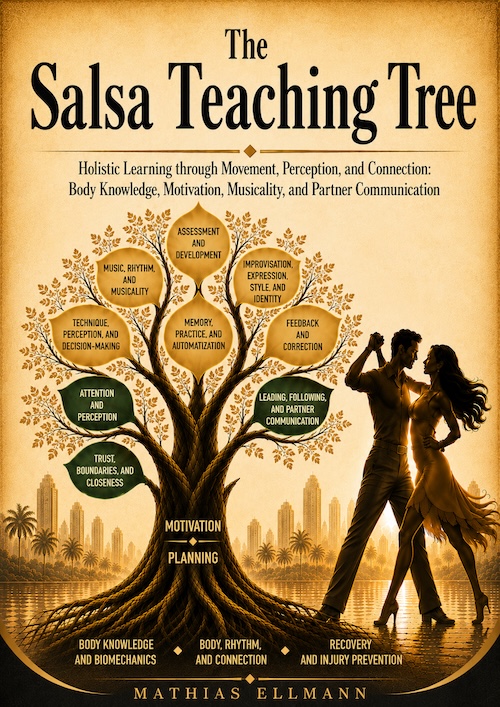
The Salsa Teaching Tree
A holistic orientation model for salsa learning and teaching that goes beyond collecting steps and figures and connects body organization, music, perception, decision-making and partner communication.
View The Salsa Teaching TreeConcept · Salsa knowledge · learning · partner communication
Mathias Ellmann

Mathias Ellmann develops the Salsa Movement Lexicon as a connection between dance technique, body knowledge, musicality, learning and partner communication.
Movement is not considered only in terms of which steps or figures are danced, but also how weight, timing, space, perception and connection interact.
Leading and following are treated as reciprocal communication: one person prepares movement possibilities and makes them perceptible, while the other responds through self-organized movement. Both roles remain perceptive, adaptive and autonomous.