Shines & Footwork
01 · Term and function
What is Rumba Step?
Side-oriented solo step using deliberate weight transfer and a delayed hip response.
on1, on2
Solo
On1 · On2
02 · Positions, timing and variants
Starting point, direction and variants
Timing, role context and spatial orientation are described separately. Names and execution details can vary across salsa styles, schools and regions.
Rumba basic
Shines & Footwork
solo, shines
on1, on2
Note: Shine names are not fully standardized across salsa communities; the movement logic described here is the primary reference.
03 · Technical execution
What matters in Rumba Step
The Rumba Step on this salsa-shine page uses a deliberate lateral weight transfer. The term is used differently across dance traditions, so this entry does not imply a complete ballroom-rumba technique.
The new supporting foot accepts body weight in control. This frees the other foot and allows the following body response to develop.
Visible pelvic movement follows organization through the supporting leg and weight transfer. The hip is not independently pushed sideways away from the legs.
A small lateral step makes complete weight acceptance easier and prevents the upper body from tilting to compensate.
Depending on the musical execution, body or hip response may follow perceptibly after the step itself. It remains connected to weight and rhythm.
04 · Body knowledge
Body organization in Rumba Step
The Rumba Step described on this salsa-shine page places body weight onto a new supporting foot laterally. The term is used differently across dance traditions and therefore does not define one universal rumba technique.
Visible hip and pelvic action develops through weight acceptance and leg organization. It is not pushed sideways independently from the legs.
A body response that follows slightly after the step may characterize the movement, but it remains a consequence of support organization rather than a separately held pose.
05 · For beginners
Build Rumba Step clearly first
Begin with small lateral weight changes and make sure the previous foot becomes completely free each time.
Then add the natural pelvic and torso response without trying to force a fixed hip position.
After every lateral transfer, can you lift the previous foot while upper body and pelvis remain free rather than held in place?
06 · Teaching and feedback
What to observe in a controlled Rumba Step
The body center organizes over the weighted foot instead of remaining suspended between both feet.
Pelvic movement matches leg and weight organization rather than being added as an isolated side action.
Any delayed quality appears as a flowing consequence of the transfer rather than an abruptly frozen finishing position.
07 · Continue learning
From Rumba Step to related movements
Solo step in which one foot crosses behind the other, creating a compact preparation for direction change or turn.
Relaxed groove-oriented solo step with pronounced knee, hip, and upper-body response to the musical pulse.
Solo step in which one foot crosses in front of the other, preparing a new lateral or diagonal direction.
Cross step behind or in front of the standing leg followed by a weight transfer, often used to connect shines or turns.
Forward or backward break with a clear return to the original foot, used as a rhythmic solo element in salsa.
Gliding step variation in which one foot visually tracks the floor while weight transfers in a controlled way to the supporting foot.
Lateral sequence of side step, cross, and side step that travels continuously through space.
Footwork pattern combining heel and toe contacts rhythmically while keeping body weight controlled over the base.
Three-part action of kick, brief ball-of-foot weight transfer, and change to the other foot, often used syncopated.
Additional professional background
Book on learning, body knowledge and partner communication
The movement lexicon complements The Salsa Teaching Tree by Mathias Ellmann. The book connects movement, perception and partner communication with body knowledge, motivation, musicality and sustainable learning.
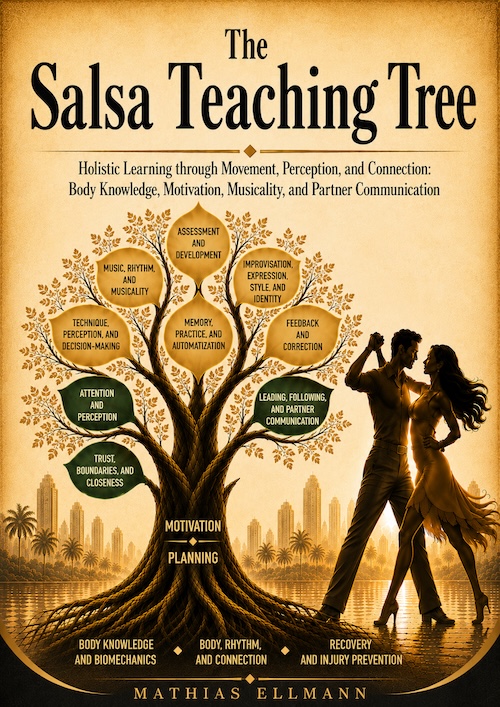
The Salsa Teaching Tree
A holistic orientation model for salsa learning and teaching that goes beyond collecting steps and figures and connects body organization, music, perception, decision-making and partner communication.
View The Salsa Teaching TreeConcept · Salsa knowledge · learning · partner communication
Mathias Ellmann

Mathias Ellmann develops the Salsa Movement Lexicon as a connection between dance technique, body knowledge, musicality, learning and partner communication.
Movement is not considered only in terms of which steps or figures are danced, but also how weight, timing, space, perception and connection interact.
Leading and following are treated as reciprocal communication: one person prepares movement possibilities and makes them perceptible, while the other responds through self-organized movement. Both roles remain perceptive, adaptive and autonomous.