Shines & Footwork
01 · Term and function
What is Heel-Toe?
Footwork pattern combining heel and toe contacts rhythmically while keeping body weight controlled over the base.
on1, on2
Solo
On1 · On2
02 · Positions, timing and variants
Starting point, direction and variants
Timing, role context and spatial orientation are described separately. Names and execution details can vary across salsa styles, schools and regions.
Heel toe step
Shines & Footwork
solo, shines
on1, on2
Note: Shine names are not fully standardized across salsa communities; the movement logic described here is the primary reference.
03 · Technical execution
What matters in Heel-Toe
Heel-Toe combines a heel contact with a following toe or ball-of-foot orientation. The two foot actions remain visually and functionally distinct.
Depending on the variation, a heel or toe contact may be unweighted or part of a weight transfer. The actual supporting foot therefore remains clear throughout.
The relationship between heel and forefoot comes from controlled movement through the foot and ankle rather than twisting the knee.
Contacts remain close enough to the dancer's base for balance and rhythm to stay controlled even at higher speed.
Heel-Toe may be used as a single accent or as a repeated footwork pattern. Exact count placement depends on phrase and variation.
04 · Body knowledge
Body organization in Heel-Toe
Heel-Toe uses clearly differentiated heel and toe or forefoot actions. Contact, foot orientation, and actual loading do not have to be identical.
The visible change between heel and forefoot comes from controlled foot and ankle action. The knee is not twisted as a substitute.
During free-foot actions, the body center remains controlled over the supporting base until a deliberate weight transfer occurs.
05 · For beginners
Build Heel-Toe clearly first
Place heel and forefoot slowly first and deliberately distinguish floor contact from actual weight acceptance.
With each change of foot orientation, check that knee and foot continue to work in a compatible direction.
Is it always clear which foot truly carries weight even when the other changes quickly between heel and forefoot contact?
06 · Teaching and feedback
What to observe in a controlled Heel-Toe
Heel and forefoot actions remain clear rather than becoming unspecific rocking of the foot.
Rotation is organized through foot and ankle without visible counter-twisting at the knee.
Touch actions and weight-bearing actions can be distinguished.
07 · Continue learning
From Heel-Toe to related movements
Reversed footwork pattern using toe and heel contacts, often used as a variation or counter-phrase to heel-toe.
Solo step in which one foot crosses behind the other, creating a compact preparation for direction change or turn.
Relaxed groove-oriented solo step with pronounced knee, hip, and upper-body response to the musical pulse.
Solo step in which one foot crosses in front of the other, preparing a new lateral or diagonal direction.
Lateral sequence of side step, cross, and side step that travels continuously through space.
Cross step behind or in front of the standing leg followed by a weight transfer, often used to connect shines or turns.
Three-part action of kick, brief ball-of-foot weight transfer, and change to the other foot, often used syncopated.
Forward or backward break with a clear return to the original foot, used as a rhythmic solo element in salsa.
Rhythmically elastic solo step with a characteristic forward-and-back play of the feet and body weight.
Additional professional background
Book on learning, body knowledge and partner communication
The movement lexicon complements The Salsa Teaching Tree by Mathias Ellmann. The book connects movement, perception and partner communication with body knowledge, motivation, musicality and sustainable learning.
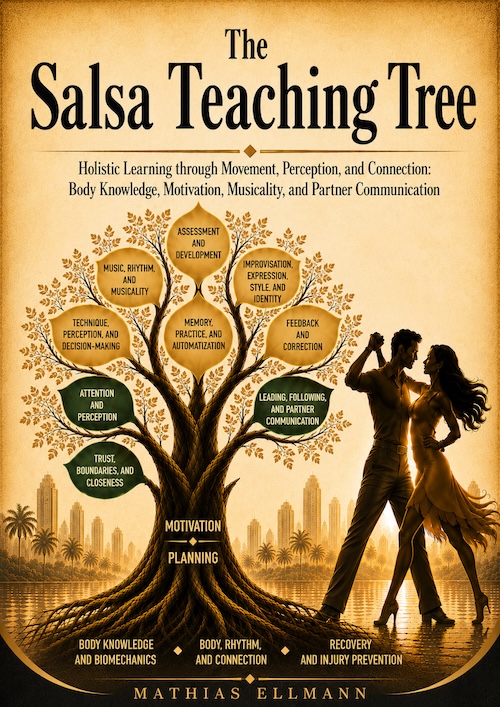
The Salsa Teaching Tree
A holistic orientation model for salsa learning and teaching that goes beyond collecting steps and figures and connects body organization, music, perception, decision-making and partner communication.
View The Salsa Teaching TreeConcept · Salsa knowledge · learning · partner communication
Mathias Ellmann

Mathias Ellmann develops the Salsa Movement Lexicon as a connection between dance technique, body knowledge, musicality, learning and partner communication.
Movement is not considered only in terms of which steps or figures are danced, but also how weight, timing, space, perception and connection interact.
Leading and following are treated as reciprocal communication: one person prepares movement possibilities and makes them perceptible, while the other responds through self-organized movement. Both roles remain perceptive, adaptive and autonomous.