Casino Partner Figures
01 · Term and function
What is Coca-Cola?
Coca-Cola can denote the Follow’s traveling left turn layered onto a Casino walking/Dile-que-no passage. The rotation is superimposed on continuing travel rather than performed as a stationary spot turn.
a-tiempo, contratiempo
Lead, Follow
a tiempo · contratiempo
02 · Positions, timing and variants
Starting point, direction and variants
Timing, role context and spatial orientation are described separately. Names and execution details can vary across salsa styles, schools and regions.
Coca cola
Casino Partner Figures
casino, rueda
a-tiempo, contratiempo
Note: Naming and exact sequencing may vary by region or school. This entry describes a widely encountered core idea and does not claim a worldwide rueda standard.
03 · Technical execution
What matters in Coca-Cola
On this page, Coca-Cola denotes a traveling left turn for the Follow. Rotation remains connected to continuing walking movement.
The Follow continues traveling through the Casino walking or Dile-que-no passage while rotating rather than turning on a fixed spot.
The Lead opens and accompanies the required pathway. Connection supports direction and orientation without pulling the Follow through the left turn.
Steps, weight acceptance, and rotation are coordinated together; a stationary spot turn would change the character described here.
After the traveling rotation, both dancers regain an orientation from which the underlying walking or Dile-que-no passage can continue or finish in a controlled way.
04 · Body knowledge
Body organization in Coca-Cola
In common versions, Coca-Cola combines a Casino passing or opening organization with additional rotation of the follow. The exact sequence can vary between schools.
The follow organizes the added direction changes through personal steps and weight. The figure should not become a stationary turn that is then pushed onward through arm force.
Because spatial direction and orientation may change several times, the lead continually adapts position and avoids blocking the next pathway with the body or arm.
05 · For beginners
Build Coca-Cola clearly first
Practice the underlying Casino passage without the additional rotation and add the turn only once the spatial organization is clear.
Reduce Coca-Cola to one additional direction change first before dancing the complete local variation.
Can the follow travel and rotate without stopping beneath the hand or being moved into the next direction through arm force?
06 · Teaching and feedback
What to observe in a controlled Coca-Cola
The next turning direction becomes readable early rather than being created afterward through an abrupt hand action.
The follow can complete the sequence without unintended stops or corrective detours.
The selected Coca-Cola sequence preserves its hand, turning, and exit logic without being presented as the only universal execution.
07 · Continue learning
From Coca-Cola to related movements
Alias entry for the same closed-position Casino base action as Adentro y afuera: rhythmic opening and closing of the couple space with elastic weight transfer. Regionally the name does not identify a uniquely different choreography.
Bayamo denotes a family of Casino figures with crossed two-hand connection and a Rodeo-Inverso-like circular pathway as a recurring core idea. Entries and exits vary; Sombrero is a possible but not defining resolution.
In common Casino versions, El Dedo combines a guided Follow right turn with Enchufla or a Follow left turn, a Lead right/outward turn, and Dile que no. Starting handhold varies; right-to-right is documented alongside other one-hand variations.
Fundamental Casino figure and common transition from closed to open position: the Follow passes the Lead on a curved walking pathway while the Lead opens space, and both finish oriented toward each other again.
The name Dile que sí is school-dependent. One couple variant uses a hand-held Vacílala from open position to bring the Follow back into closed or near-closed couple position.
Extended Sombrero figure using several successive two-hand and side-changing pathways. One common version begins with Sombrero, moves into a reverse-Sombrero-like return pathway, and then uses further turning and hand pathways before resolving with Dile que no.
A Casino shadow figure in which the Lead is in front of the Follow, back toward the Follow, and both walk/pivot in the same general direction before the connection is resolved.
Casino shadow figure using aligned or offset partner organization. In one common version the Lead is temporarily behind the Follow while both travel or pivot in a similar direction; other El Uno conventions organize the relative front/back position differently.
Compact Casino turn-and-place-change figure in which the follow turns under the hand and the couple re-establishes orientation.
Additional professional background
Book on learning, body knowledge and partner communication
The movement lexicon complements The Salsa Teaching Tree by Mathias Ellmann. The book connects movement, perception and partner communication with body knowledge, motivation, musicality and sustainable learning.
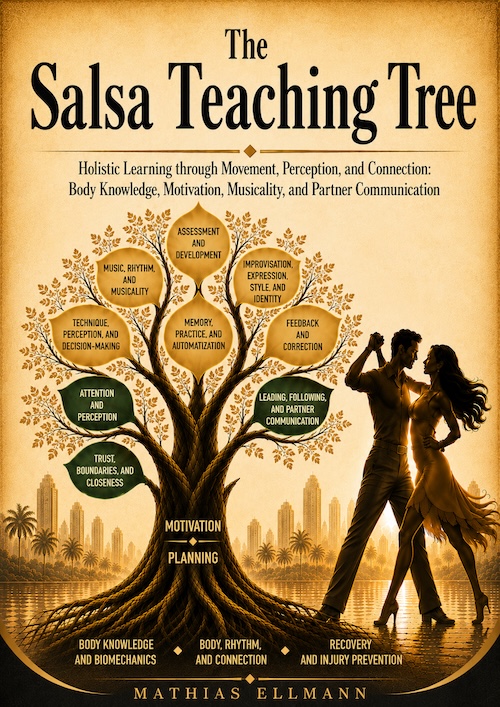
The Salsa Teaching Tree
A holistic orientation model for salsa learning and teaching that goes beyond collecting steps and figures and connects body organization, music, perception, decision-making and partner communication.
View The Salsa Teaching TreeConcept · Salsa knowledge · learning · partner communication
Mathias Ellmann

Mathias Ellmann develops the Salsa Movement Lexicon as a connection between dance technique, body knowledge, musicality, learning and partner communication.
Movement is not considered only in terms of which steps or figures are danced, but also how weight, timing, space, perception and connection interact.
Leading and following are treated as reciprocal communication: one person prepares movement possibilities and makes them perceptible, while the other responds through self-organized movement. Both roles remain perceptive, adaptive and autonomous.