Linear Partnerwork
01 · Term and function
What is Open Break?
Both partners create temporary distance through a controlled break while preserving elastic connection through the hands.
on1, on2
Lead, Follow
On1 · On2
02 · Positions, timing and variants
Starting point, direction and variants
Timing, role context and spatial orientation are described separately. Names and execution details can vary across salsa styles, schools and regions.
Open rock
Linear Partnerwork
linear, cross-style
on1, on2
03 · Technical execution
What matters in Open Break
In an Open Break, both partners move away from one another in a controlled manner and temporarily increase the shared distance.
Both dancers accept their own body weight in the break step. Partner connection does not carry the other person's weight.
As distance increases, a light elastic quality develops in the connection. It communicates the opposing movement without becoming a jerk or pull.
Distance is created primarily through steps and movement of the body centers. The arms extend the connection rather than pulling the bodies apart.
From the Open Break, distance can be reduced again or a following figure prepared. The directional change remains readable through the existing elastic connection.
04 · Body knowledge
Body organization in Open Break
In an Open Break, both dancers increase distance through their own weight pathways. The arms are not used to push the bodies away from one another.
As distance increases, connection may become clear while remaining mobile. Elbows and shoulders stay available rather than locking at maximum arm reach.
The following approach or figure develops from the next weight change rather than one dancer pulling the other back through the hands.
05 · For beginners
Build Open Break clearly first
Practice a small Open Break first and stop increasing partner space before the arms or shoulders reach their end range.
Briefly lighten the hand connection and check whether both dancers can still support their own backward position.
Is distance created mainly through your steps, or only when the arms become fully extended?
06 · Teaching and feedback
What to observe in a controlled Open Break
Neither dancer hangs from the other's arm to hold the backward position.
Hands, elbows, and shoulders retain movement reserve rather than being pulled into a hard end position.
The return or following figure begins through the feet rather than an abrupt arm pull.
07 · Continue learning
From Open Break to related movements
Arm pathway in which a connected hand is guided over one's own or the partner's head and then released into a relaxed position.
Controlled release from a wrap position through opening of the arms and an appropriate counter-rotation or continuation of the follow.
Partner position in which the follow is guided into a compact wrapped position beside or in front of the lead without locking shoulder or elbow.
Linear figure that redirects or checks the follow's forward travel before returning them to the pathway.
Advanced linear passage in which the shared orientation is rebuilt through a larger circular rotation while the follow continues to travel through the lane.
The lead opens the pathway and guides the follow through the slot to the opposite side; both finish reoriented toward one another.
Hand-and-arm position in which a forearm is guided behind the follow's back; the shoulder remains free and the range is kept limited.
A brief release or redirection of hand connection used to prepare a new hand position without throwing or pulling the partner.
A cross-body structure using the opposite opening or passing direction from the common basic form.
Additional professional background
Book on learning, body knowledge and partner communication
The movement lexicon complements The Salsa Teaching Tree by Mathias Ellmann. The book connects movement, perception and partner communication with body knowledge, motivation, musicality and sustainable learning.
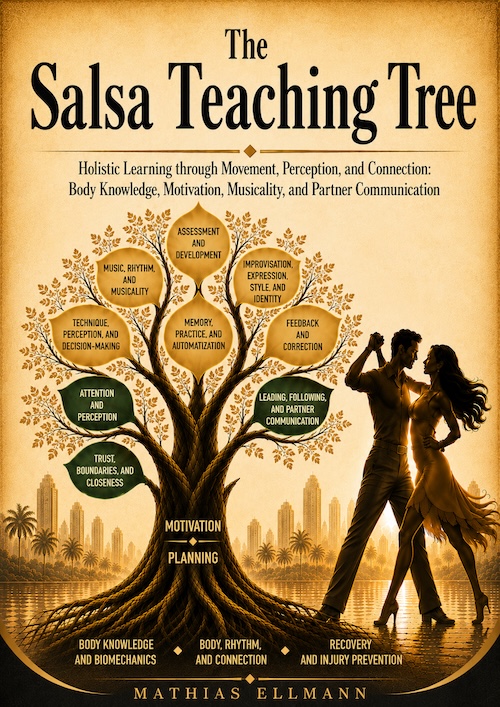
The Salsa Teaching Tree
A holistic orientation model for salsa learning and teaching that goes beyond collecting steps and figures and connects body organization, music, perception, decision-making and partner communication.
View The Salsa Teaching TreeConcept · Salsa knowledge · learning · partner communication
Mathias Ellmann

Mathias Ellmann develops the Salsa Movement Lexicon as a connection between dance technique, body knowledge, musicality, learning and partner communication.
Movement is not considered only in terms of which steps or figures are danced, but also how weight, timing, space, perception and connection interact.
Leading and following are treated as reciprocal communication: one person prepares movement possibilities and makes them perceptible, while the other responds through self-organized movement. Both roles remain perceptive, adaptive and autonomous.