Linear Partnerwork
01 · Term and function
What is Hand Toss?
A brief release or redirection of hand connection used to prepare a new hand position without throwing or pulling the partner.
on1, on2
Lead, Follow
On1 · On2
02 · Positions, timing and variants
Starting point, direction and variants
Timing, role context and spatial orientation are described separately. Names and execution details can vary across salsa styles, schools and regions.
Hand change toss
Linear Partnerwork
linear, on1, on2
on1, on2
03 · Technical execution
What matters in Hand Toss
In a Hand Toss, an existing hand connection is briefly released, redirected, or transferred into a new hand position.
The word toss describes the hand organization. Neither the partner's arm nor body is thrown, lifted, or accelerated.
Directional information remains small and clear. An oversized arm action makes reconnection harder and can create unnecessary tension.
After release, the new contact opportunity is presented so the partner can reach it without hurried searching.
The hand change is complete when the new connection is stable and functional for the following figure; creating that usable connection is the purpose of the action.
04 · Body knowledge
Body organization in Hand Toss
In a Hand Toss, hand connection changes briefly. The name describes a release or hand-change action, not an impulse that throws the other dancer's body through space.
A short, mainly vertical or neutral release pathway can prepare a hand change. If a turn is also intended, it needs its own clear directional information.
Releasing or re-establishing hand connection does not change each dancer's responsibility for personal support and axis.
05 · For beginners
Build Hand Toss clearly first
Begin with only a small release and the re-offering or receiving of the hand without performing a turn at the same time.
New connection is offered and received cleanly rather than catching at the hand or fingers.
Do rhythm and balance remain unchanged even when hand connection is completely absent for a brief moment?
06 · Teaching and feedback
What to observe in a controlled Hand Toss
The hand is released deliberately rather than unexpectedly pulled out of a loaded connection.
The arm action remains small enough that the other dancer's shoulder and body axis are not dragged with it.
The new hand position is offered clearly and can be received without grabbing or abruptly stopping movement.
07 · Continue learning
From Hand Toss to related movements
Linear figure that redirects or checks the follow's forward travel before returning them to the pathway.
Advanced linear passage in which the shared orientation is rebuilt through a larger circular rotation while the follow continues to travel through the lane.
The lead opens the pathway and guides the follow through the slot to the opposite side; both finish reoriented toward one another.
A cross-body structure using the opposite opening or passing direction from the common basic form.
Partner passage in which the follow walks through an opened pathway and the connection is then reorganized.
A turn whose rotation is briefly checked or redirected through clear lead information before continuing or resolving.
A copa structure resolved into an inward follower turn.
A copa structure resolved into an outward follower turn.
A cross body lead in which the follow performs an inside rotation while traveling and then returns to the shared line.
Additional professional background
Book on learning, body knowledge and partner communication
The movement lexicon complements The Salsa Teaching Tree by Mathias Ellmann. The book connects movement, perception and partner communication with body knowledge, motivation, musicality and sustainable learning.
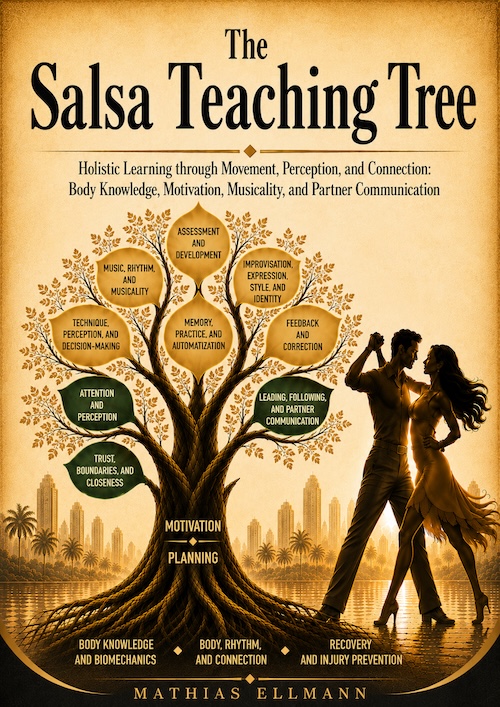
The Salsa Teaching Tree
A holistic orientation model for salsa learning and teaching that goes beyond collecting steps and figures and connects body organization, music, perception, decision-making and partner communication.
View The Salsa Teaching TreeConcept · Salsa knowledge · learning · partner communication
Mathias Ellmann

Mathias Ellmann develops the Salsa Movement Lexicon as a connection between dance technique, body knowledge, musicality, learning and partner communication.
Movement is not considered only in terms of which steps or figures are danced, but also how weight, timing, space, perception and connection interact.
Leading and following are treated as reciprocal communication: one person prepares movement possibilities and makes them perceptible, while the other responds through self-organized movement. Both roles remain perceptive, adaptive and autonomous.