Linear Partnerwork
01 · Term and function
What is Copa with Outside Turn?
A copa structure resolved into an outward follower turn.
on1, on2
Lead, Follow
On1 · On2
02 · Positions, timing and variants
Starting point, direction and variants
Timing, role context and spatial orientation are described separately. Names and execution details can vary across salsa styles, schools and regions.
Copa outside
Linear Partnerwork
linear, on1, on2
on1, on2
03 · Technical execution
What matters in Copa with Outside Turn
This variation also begins with the Copa entry: forward travel for the Follow, a controlled check or directional change, and a subsequent resolution.
The outward turn is clearly prepared before rotation begins. Connection makes the directional change readable without suddenly redirecting the Follow.
The Follow turns along a free outside rotational pathway. Steps and weight organize the turn; the arms remain a channel of information rather than the motor of rotation.
The Lead remains outside the required turning and walking pathway. This allows the Follow to complete the outside rotation without losing the linear lane.
After the turn, connection is reorganized so both dancers regain a stable shared line and a clear direction for continuation.
04 · Body knowledge
Body organization in Copa with Outside Turn
After the checked Copa position, the movement pathway opens so the follow can continue into an outside rotational path.
Lead position and connection stay clear so the follow does not need to detour around the lead.
Connection communicates direction and timing of the resolution while balance and rotational axis remain with the follow.
05 · For beginners
Build Copa with Outside Turn clearly first
Practice reopening space from the check before adding a turn.
Communicate the outside direction early enough for the follow to organize it with the following weight transfer.
Can the follow turn outward without the hand or lead position displacing the personal axis sideways?
06 · Teaching and feedback
What to observe in a controlled Copa with Outside Turn
The Copa is not held and forced into the outside turn at the same time.
Neither the lead nor a crossing arm blocks the rotational pathway.
Direction and continuation stay readable without pulling the dancer through the turn.
07 · Continue learning
From Copa with Outside Turn to related movements
A copa structure resolved into an inward follower turn.
A cross body lead with an outward follower turn during the pass, maintaining the linear travel pathway.
A follower turn toward the outside of the shared pathway, with the lead providing a free and readable rotational track.
A turn whose rotation is briefly checked or redirected through clear lead information before continuing or resolving.
A cross body lead in which the follow performs an inside rotation while traveling and then returns to the shared line.
The follow turns left from a prepared axis and completes the action with clearly settled weight on the intended foot.
The follow executes a right turn from a clear preparation and finishes with controlled re-establishment of the axis.
A follower turn toward the inside of the shared pathway, typically initiated from a linear pass or cross-body structure.
The lead rotates left, keeping rotational impulse small enough to preserve timing and partner relationship without over-turning.
Additional professional background
Book on learning, body knowledge and partner communication
The movement lexicon complements The Salsa Teaching Tree by Mathias Ellmann. The book connects movement, perception and partner communication with body knowledge, motivation, musicality and sustainable learning.
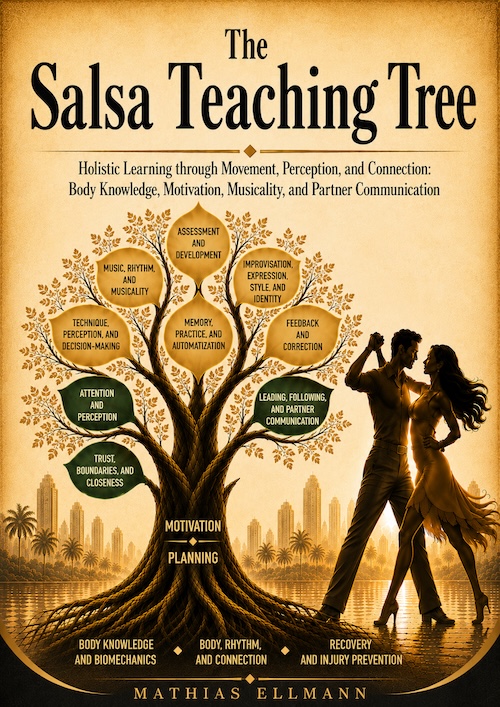
The Salsa Teaching Tree
A holistic orientation model for salsa learning and teaching that goes beyond collecting steps and figures and connects body organization, music, perception, decision-making and partner communication.
View The Salsa Teaching TreeConcept · Salsa knowledge · learning · partner communication
Mathias Ellmann

Mathias Ellmann develops the Salsa Movement Lexicon as a connection between dance technique, body knowledge, musicality, learning and partner communication.
Movement is not considered only in terms of which steps or figures are danced, but also how weight, timing, space, perception and connection interact.
Leading and following are treated as reciprocal communication: one person prepares movement possibilities and makes them perceptible, while the other responds through self-organized movement. Both roles remain perceptive, adaptive and autonomous.