Linear Partnerwork
01 · Term and function
What is Follow Right Turn?
The follow executes a right turn from a clear preparation and finishes with controlled re-establishment of the axis.
on1, on2
Lead, Follow
On1 · On2
02 · Positions, timing and variants
Starting point, direction and variants
Timing, role context and spatial orientation are described separately. Names and execution details can vary across salsa styles, schools and regions.
Follower right turn
Linear Partnerwork
linear, on1, on2
on1, on2
03 · Technical execution
What matters in Follow Right Turn
The Follow Right Turn begins with a clear preparation. It communicates the upcoming direction early enough without already forcing rotation.
The Follow organizes steps, weight, and axis independently. The Lead communicates direction and timing but does not pull the Follow through the turn by hand or arm.
When connected, the hand pathway travels with sufficient height and shoulder freedom above or around the head area.
During the turn, the body center remains controllable over the changing supporting sides. Speed is not created by large lateral displacement of the upper body.
The turn finishes with restored balance and clear couple orientation. Exact timing placement can vary between On1, On2, and other teaching conventions.
04 · Body knowledge
Body organization in Follow Right Turn
The right turn is prepared so the follow has a clear supporting side and sufficient personal space before rotation begins.
Leading communicates direction and timing. It does not create the turn by pulling the arm or circling the hand around the head.
When hand connection is present, it travels in a shoulder-friendly area while leaving the follow's head, shoulder, and axis organization independent.
05 · For beginners
Build Follow Right Turn clearly first
The follow practices preparation, rotation, and finishing weight independently.
Add partner contact afterward and test how little hand information is needed for a clear rightward direction.
Can the follow complete the right turn on personal balance without needing to hold onto the hand?
06 · Teaching and feedback
What to observe in a controlled Follow Right Turn
The follow receives directional information before actual rotation begins.
The hand pathway pulls the dancer neither sideways nor upward out of support organization.
The turn ends with clear weight and without an additional catching step.
07 · Continue learning
From Follow Right Turn to related movements
The follow turns left from a prepared axis and completes the action with clearly settled weight on the intended foot.
The lead rotates to the right within salsa timing, coordinating foot placement, spotting, and connection so partner communication remains available.
Guided right turn beneath a raised hand connection; the arm creates space for rotation without pulling on the head or arm.
A turn whose rotation is briefly checked or redirected through clear lead information before continuing or resolving.
A copa structure resolved into an inward follower turn.
A copa structure resolved into an outward follower turn.
A cross body lead in which the follow performs an inside rotation while traveling and then returns to the shared line.
A cross body lead with an outward follower turn during the pass, maintaining the linear travel pathway.
A follower turn toward the inside of the shared pathway, typically initiated from a linear pass or cross-body structure.
Additional professional background
Book on learning, body knowledge and partner communication
The movement lexicon complements The Salsa Teaching Tree by Mathias Ellmann. The book connects movement, perception and partner communication with body knowledge, motivation, musicality and sustainable learning.
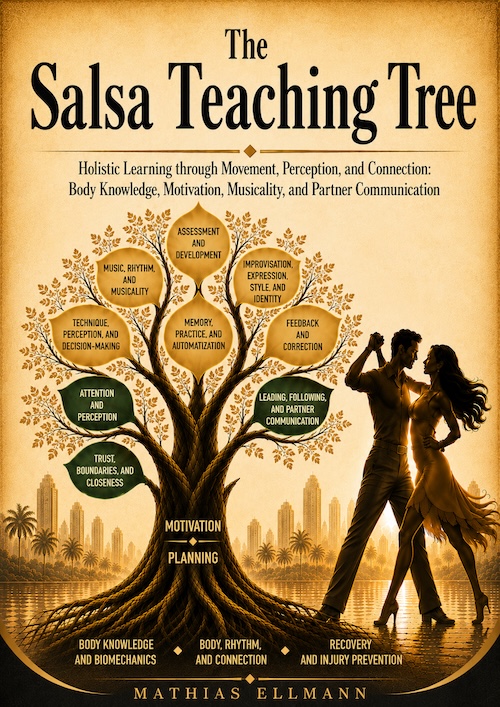
The Salsa Teaching Tree
A holistic orientation model for salsa learning and teaching that goes beyond collecting steps and figures and connects body organization, music, perception, decision-making and partner communication.
View The Salsa Teaching TreeConcept · Salsa knowledge · learning · partner communication
Mathias Ellmann

Mathias Ellmann develops the Salsa Movement Lexicon as a connection between dance technique, body knowledge, musicality, learning and partner communication.
Movement is not considered only in terms of which steps or figures are danced, but also how weight, timing, space, perception and connection interact.
Leading and following are treated as reciprocal communication: one person prepares movement possibilities and makes them perceptible, while the other responds through self-organized movement. Both roles remain perceptive, adaptive and autonomous.