Linear Partnerwork
01 · Term and function
What is Hammerlock?
Hand-and-arm position in which a forearm is guided behind the follow's back; the shoulder remains free and the range is kept limited.
on1, on2 · Casino: a-tiempo, contratiempo
Lead, Follow
On1 · On2 · a tiempo · contratiempo
02 · Positions, timing and variants
Starting point, direction and variants
Timing, role context and spatial orientation are described separately. Names and execution details can vary across salsa styles, schools and regions.
Arm-behind-back position
Linear Partnerwork
linear, casino
on1, on2 · Casino: a-tiempo, contratiempo
03 · Technical execution
What matters in Hammerlock
A Hammerlock position is created through the preceding turn or arm organization. The forearm is not subsequently forced behind the back.
The position remains within the individual's available shoulder mobility. Depth or tightness of the arm position is not a measure of quality.
The hand remains controlled but mobile in connection. Excessive gripping restricts the natural response of wrist, elbow, and shoulder.
Lead and Follow organize spacing and body position so the arm shape does not have to be maintained through joint tension alone.
A Hammerlock needs a clear release pathway. Sufficient arm and shoulder space is created before the next turn or unwind begins.
04 · Body knowledge
Body organization in Hammerlock
A Hammerlock position develops through coordinated turning and hand organization so one arm arrives behind the back in control. The arm is not pushed into that position independently from the body.
Range behind the back remains within the dancer's freely available shoulder movement. A larger shape is not a marker of better execution.
The wrist and forearm are not used as levers to tighten the position. When range is limited, the connection stays smaller or is released.
05 · For beginners
Build Hammerlock clearly first
Practice the underlying turn first and allow the body pathway to bring the arm behind the back.
Stop where shoulder and arm remain free rather than trying to create a visually larger wrap.
Can the dancer remain independently balanced in the Hammerlock and release the arm again without pressure or twisting?
06 · Teaching and feedback
What to observe in a controlled Hammerlock
The position develops from rotation and connection; visible pushing, levering upward, or twisting of the arm is not part of the technique.
The rear arm position stays small enough that shoulder and elbow are not forced toward a loaded end range.
Connection can be lightened or released when available movement range decreases or resistance appears.
07 · Continue learning
From Hammerlock to related movements
Linear figure that redirects or checks the follow's forward travel before returning them to the pathway.
Advanced linear passage in which the shared orientation is rebuilt through a larger circular rotation while the follow continues to travel through the lane.
The lead opens the pathway and guides the follow through the slot to the opposite side; both finish reoriented toward one another.
Arm pathway in which a connected hand is guided over one's own or the partner's head and then released into a relaxed position.
A brief release or redirection of hand connection used to prepare a new hand position without throwing or pulling the partner.
Both partners create temporary distance through a controlled break while preserving elastic connection through the hands.
A cross-body structure using the opposite opening or passing direction from the common basic form.
Controlled release from a wrap position through opening of the arms and an appropriate counter-rotation or continuation of the follow.
Partner passage in which the follow walks through an opened pathway and the connection is then reorganized.
Additional professional background
Book on learning, body knowledge and partner communication
The movement lexicon complements The Salsa Teaching Tree by Mathias Ellmann. The book connects movement, perception and partner communication with body knowledge, motivation, musicality and sustainable learning.
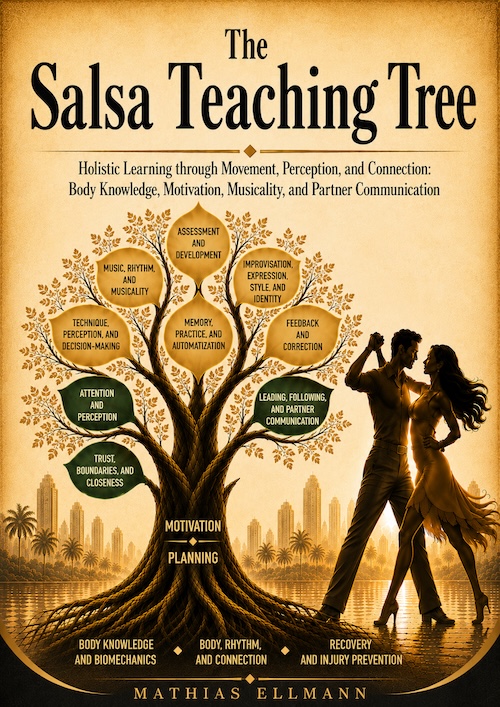
The Salsa Teaching Tree
A holistic orientation model for salsa learning and teaching that goes beyond collecting steps and figures and connects body organization, music, perception, decision-making and partner communication.
View The Salsa Teaching TreeConcept · Salsa knowledge · learning · partner communication
Mathias Ellmann

Mathias Ellmann develops the Salsa Movement Lexicon as a connection between dance technique, body knowledge, musicality, learning and partner communication.
Movement is not considered only in terms of which steps or figures are danced, but also how weight, timing, space, perception and connection interact.
Leading and following are treated as reciprocal communication: one person prepares movement possibilities and makes them perceptible, while the other responds through self-organized movement. Both roles remain perceptive, adaptive and autonomous.