Foundations & Timing
01 · Term and function
What is Basic Step On1?
Six weight changes across eight counts with directional breaks on 1 and 5; counts 4 and 8 carry no regular step.
on1
Lead, Follow
On1
02 · Positions, timing and variants
Starting point, direction and variants
Timing, role context and spatial orientation are described separately. Names and execution details can vary across salsa styles, schools and regions.
LA Basic · On1 Basic
Foundations & Timing
linear, on1
on1
03 · Technical execution
What matters in Basic Step On1
The On1 basic uses six regular weight changes across eight counts: 1-2-3 and 5-6-7. Counts 4 and 8 do not add another regular step.
The functional directional changes fall on 1 and 5. A break is a weighted step followed by reversal of travel, not merely a foot contact.
Each regular step clearly accepts body weight. This keeps it distinct from a tap and gives the next step a clear supporting side.
Forward and backward travel remains controlled. A break does not require a large lunge; weight transfer and directional reversal are the essential actions.
There is no regular step on 4 and 8, but body organization and musical pulse continue. A pause does not mean freezing.
04 · Body knowledge
Body organization in Basic Step On1
In this organization, directional breaks occur on 1 and 5. This gives the two halves of the phrase a clearly comparable structure.
Across eight counts there are six regular weight transfers. Clarity comes from complete loading rather than from maximizing foot contacts.
There is no regular step on 4 and 8, but body rhythm and readiness for the next break continue.
05 · For beginners
Build Basic Step On1 clearly first
Practice 1-2-3 and 5-6-7 slowly and check on every number that weight has actually reached the intended foot.
Do not add a replacement step on 4 or 8. Use that time to organize the supporting side.
Can you begin the next break on 1 or 5 without inserting a small corrective step first?
06 · Teaching and feedback
What to observe in a controlled Basic Step On1
The functional direction changes are clearly visible on 1 and 5.
No unintended additional weight transfer appears on 4 or 8.
1-2-3 and 5-6-7 show comparable loading quality and controlled return.
07 · Continue learning
From Basic Step On1 to related movements
New York/Eddie Torres On2 basic with six regular weight changes on 1-2-3 and 5-6-7. Directional breaks occur on 2 and 6; counts 4 and 8 carry no regular step. Other On2 traditions use different step placements; this page explicitly describes the ET2/NY organization.
Foundational Cuban Casino organization using elastic weight changes, natural rotation, and circular spatial orientation rather than a strict linear slot.
A basic organized around counter-time emphasis, placing directional changes so the movement responds more strongly to the offbeat structure.
Linear figure that redirects or checks the follow's forward travel before returning them to the pathway.
Advanced linear passage in which the shared orientation is rebuilt through a larger circular rotation while the follow continues to travel through the lane.
The lead opens the pathway and guides the follow through the slot to the opposite side; both finish reoriented toward one another.
Alternating backward break with a slight lateral opening, commonly used as a relaxed basic variation in social salsa.
A brief release or redirection of hand connection used to prepare a new hand position without throwing or pulling the partner.
Salsa rhythm marked almost in place to train timing, foot pressure, and body movement without substantial travel.
Additional professional background
Book on learning, body knowledge and partner communication
The movement lexicon complements The Salsa Teaching Tree by Mathias Ellmann. The book connects movement, perception and partner communication with body knowledge, motivation, musicality and sustainable learning.
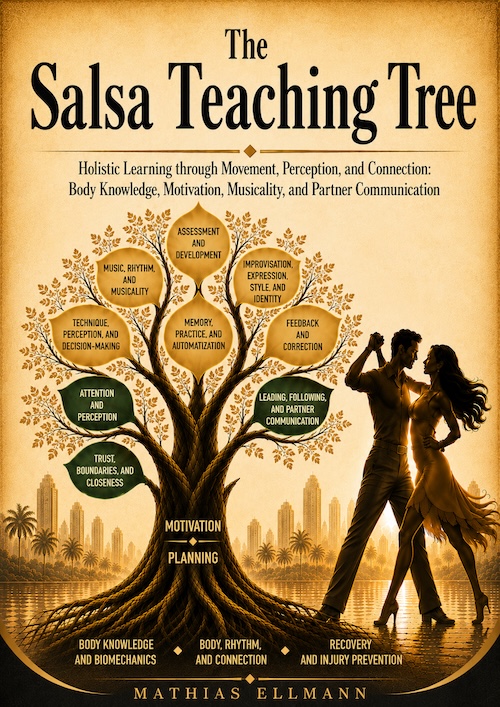
The Salsa Teaching Tree
A holistic orientation model for salsa learning and teaching that goes beyond collecting steps and figures and connects body organization, music, perception, decision-making and partner communication.
View The Salsa Teaching TreeConcept · Salsa knowledge · learning · partner communication
Mathias Ellmann

Mathias Ellmann develops the Salsa Movement Lexicon as a connection between dance technique, body knowledge, musicality, learning and partner communication.
Movement is not considered only in terms of which steps or figures are danced, but also how weight, timing, space, perception and connection interact.
Leading and following are treated as reciprocal communication: one person prepares movement possibilities and makes them perceptible, while the other responds through self-organized movement. Both roles remain perceptive, adaptive and autonomous.