Foundations & Timing
01 · Term and function
What is In-Place Basic?
Salsa rhythm marked almost in place to train timing, foot pressure, and body movement without substantial travel.
on1, on2
Lead, Follow
On1 · On2
02 · Positions, timing and variants
Starting point, direction and variants
Timing, role context and spatial orientation are described separately. Names and execution details can vary across salsa styles, schools and regions.
Marking basic
Foundations & Timing
cross-style
on1, on2
03 · Technical execution
What matters in In-Place Basic
The In-Place Basic deliberately keeps travel small. The feet alternate support without requiring substantial forward, backward, or lateral movement.
Even with very little travel, weight clearly transfers from one supporting side to the other. Small steps are not the same as unweighted taps.
Floor contact remains active and controlled. The feet accept and release weight without unnecessary stamping or lifting the body upward.
Knees, pelvis, and torso can respond to changing support even while the dancer remains almost in the same location.
Reduced travel makes timing, supporting side, and body response easier to observe. The goal is precise weight organization rather than complete stillness.
04 · Body knowledge
Body organization in In-Place Basic
Even without significant travel, body weight transfers fully from one side to the other. Small foot pathways do not mean partial weight transfers.
The body center moves within a compact support area. Large lateral or forward-and-back travel is not required.
Knees, pelvis, and torso may respond to the changing supporting side. This body movement grows from loading rather than added bouncing.
05 · For beginners
Build In-Place Basic clearly first
Begin with a familiar salsa weight change and then reduce only the distance traveled by the feet, not the weight transfer.
On every step, identify which foot carries weight and which foot has become free.
Can you remain almost in place while still completing every weight transfer clearly?
06 · Teaching and feedback
What to observe in a controlled In-Place Basic
Position in space changes only slightly without turning the steps into unweighted taps.
After every regular step, the new supporting side is unambiguous.
Compact execution does not disturb the underlying salsa pulse or the ability to continue.
07 · Continue learning
From In-Place Basic to related movements
Alternating backward break with a slight lateral opening, commonly used as a relaxed basic variation in social salsa.
Salsa basic rhythm executed with lateral weight changes, developing width, hip response, and side-to-side spatial awareness.
Continuous walking steps within salsa timing, keeping each weight transfer distinct while shaping a deliberate pathway through space.
A backward weight transfer followed by a forward reversal, keeping the body center controlled rather than drifting excessively away from the base.
Foundational Cuban Casino organization using elastic weight changes, natural rotation, and circular spatial orientation rather than a strict linear slot.
A basic organized around counter-time emphasis, placing directional changes so the movement responds more strongly to the offbeat structure.
A forward weight transfer followed by a clear reversal back toward the base position; the break is the functional change-of-direction point.
A deliberate no-step count while body rhythm, breath, and musical tension continue.
An added or anticipated weight transfer between primary counts, increasing rhythmic density within the regular salsa pulse.
Additional professional background
Book on learning, body knowledge and partner communication
The movement lexicon complements The Salsa Teaching Tree by Mathias Ellmann. The book connects movement, perception and partner communication with body knowledge, motivation, musicality and sustainable learning.
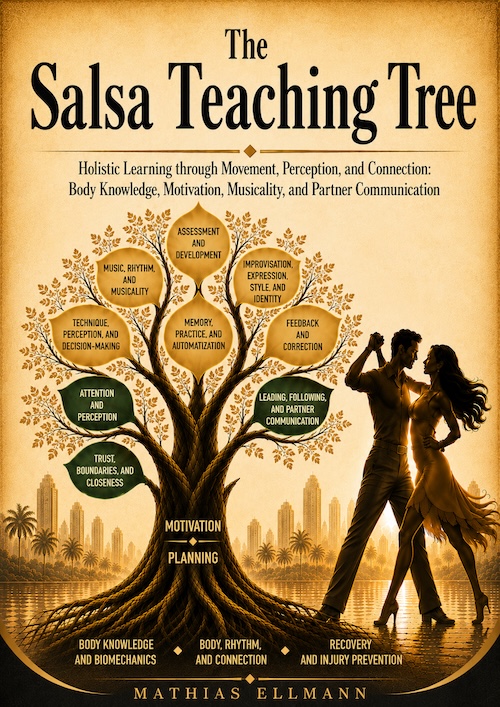
The Salsa Teaching Tree
A holistic orientation model for salsa learning and teaching that goes beyond collecting steps and figures and connects body organization, music, perception, decision-making and partner communication.
View The Salsa Teaching TreeConcept · Salsa knowledge · learning · partner communication
Mathias Ellmann

Mathias Ellmann develops the Salsa Movement Lexicon as a connection between dance technique, body knowledge, musicality, learning and partner communication.
Movement is not considered only in terms of which steps or figures are danced, but also how weight, timing, space, perception and connection interact.
Leading and following are treated as reciprocal communication: one person prepares movement possibilities and makes them perceptible, while the other responds through self-organized movement. Both roles remain perceptive, adaptive and autonomous.