Turns & Spins
01 · Term and function
What is Outside Double Turn?
Two outward follower rotations with a controlled hand pathway and early stabilization of the exit.
on1, on2
Lead, Follow
On1 · On2
02 · Positions, timing and variants
Starting point, direction and variants
Timing, role context and spatial orientation are described separately. Names and execution details can vary across salsa styles, schools and regions.
Double outside
Turns & Spins
linear, on1, on2
on1, on2
03 · Technical execution
What matters in Outside Double Turn
The Outside Double Turn combines two outward Follow rotations with the existing linear movement organization.
Direction and rotational continuity are prepared before the turn begins so the second rotation remains readable as part of the same task.
The Lead keeps sufficient space available for both rotations. The Follow should not be pushed into the Lead or sideways out of the intended pathway.
Both rotations arise from the Follow's own support and axis control. Connection provides information without pulling the dancer through two revolutions by the arm.
Before the second rotation finishes, continued turn information is reduced so the Follow can exit with controlled weight and a clear finishing orientation.
04 · Body knowledge
Body organization in Outside Double Turn
The follow needs enough space on the outside rotational side for both revolutions to occur without having to detour around the lead.
Direction and continuation are readable before or early in the turning pathway rather than only after the first outside rotation has finished.
Connection communicates direction and continuity. It does not replace personal support and axis control.
05 · For beginners
Build Outside Double Turn in control first
Practice a controlled single outside rotation with a clear spatial pathway and stable exit.
Extend to the double only when rotational space and hand pathway remain free across both revolutions.
Can the follow continue through the second rotation without being pulled outward or having to shift the personal axis around the lead?
06 · Teaching and feedback
What to observe in a controlled Outside Double Turn
Both revolutions can occur without the lead or connection blocking the required space.
Hand information neither carries weight nor pulls the rotating dancer through the outside pathway.
After the second rotation, continuation reduces early enough to create a controlled exit.
07 · Continue learning
From Outside Double Turn to related movements
Two inward follower rotations, usually initiated from a clearly prepared linear lead.
Two self-rotations by the lead within partnerwork while preserving rhythm and the connection needed for the next action.
Free follower rotation after a clear release impulse, with independent axis control until reconnection.
A copa structure resolved into an outward follower turn.
A cross body lead with an outward follower turn during the pass, maintaining the linear travel pathway.
A follower turn toward the outside of the shared pathway, with the lead providing a free and readable rotational track.
Deliberate deceleration of a turn and redirection of rotational momentum into a stable exit or follow-up figure.
A turn whose rotation is briefly checked or redirected through clear lead information before continuing or resolving.
A copa structure resolved into an inward follower turn.
Additional professional background
Book on learning, body knowledge and partner communication
The movement lexicon complements The Salsa Teaching Tree by Mathias Ellmann. The book connects movement, perception and partner communication with body knowledge, motivation, musicality and sustainable learning.
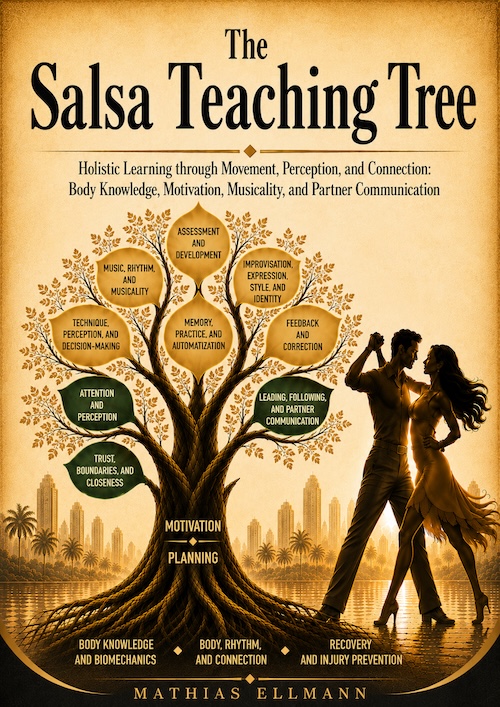
The Salsa Teaching Tree
A holistic orientation model for salsa learning and teaching that goes beyond collecting steps and figures and connects body organization, music, perception, decision-making and partner communication.
View The Salsa Teaching TreeConcept · Salsa knowledge · learning · partner communication
Mathias Ellmann

Mathias Ellmann develops the Salsa Movement Lexicon as a connection between dance technique, body knowledge, musicality, learning and partner communication.
Movement is not considered only in terms of which steps or figures are danced, but also how weight, timing, space, perception and connection interact.
Leading and following are treated as reciprocal communication: one person prepares movement possibilities and makes them perceptible, while the other responds through self-organized movement. Both roles remain perceptive, adaptive and autonomous.