Turns & Spins
01 · Term and function
What is Traveling Spin?
Multiple or sustained rotation combined with a clear forward or lateral pathway through space.
on1, on2
Solo
On1 · On2
02 · Positions, timing and variants
Starting point, direction and variants
Timing, role context and spatial orientation are described separately. Names and execution details can vary across salsa styles, schools and regions.
Travel spin
Turns & Spins
linear, solo
on1, on2
03 · Technical execution
What matters in Traveling Spin
A Traveling Spin combines sustained or multiple rotation with a clear forward, diagonal, or lateral pathway through space.
Unlike an in-place spin, the rotational axis does not remain at one fixed location. The steps continue relocating the supporting organization during rotation.
The turning dancer follows a readable path. Large unintended lateral deviations or an unplanned stop change the technical character of the movement.
Step length and rotational impulse are coordinated so the dancer neither outruns the rotation nor becomes stuck over one foot.
Rotation finishes where the traveling pathway leads. Weight and orientation stabilize at that new location rather than being corrected back toward the starting point.
04 · Body knowledge
Body organization in Traveling Spin
In a Traveling Spin, the rotational axis does not remain fixed at one point. Support changes transport it in control along an intended spatial pathway.
Step length and rotational amount are coordinated so the body neither outruns the turn nor becomes stuck over one foot while the pathway should continue.
The exit stabilizes weight and orientation where the movement has traveled. Correcting back toward the starting position conflicts with the intended travel.
05 · For beginners
Build Traveling Spin in control first
Mark the intended forward, diagonal, or lateral direction using simple steps.
Then add a smaller amount of rotation to the same pathway and increase it only while the direction of travel remains intact.
Do you actually finish at the intended new location, or does the rotation force you to correct sideways or back toward the starting line?
06 · Teaching and feedback
What to observe in a controlled Traveling Spin
The movement clearly changes location in space while rotating.
Steps continuously transport the axis rather than alternating between a stationary spin and subsequent walking.
Weight and finishing orientation stabilize at the new location without unnecessary correction backward.
07 · Continue learning
From Traveling Spin to related movements
Two rapid rotations around the body's axis using compact organization, precise preparation, and controlled exit.
Free rotation without continuous hand connection; preparation and exit therefore rely entirely on one's own axis and timing.
Preparatory counter-action or weight organization that creates rotational potential for a subsequent spin without losing the axis early.
Rotation of approximately 360 degrees organized through preparation, rotation, and controlled arrival on the intended standing foot.
Rotation of approximately 180 degrees with clear weight transfer and stable final orientation.
Turn in which one foot crosses behind or in front of the base and the crossed position is used to continue rotation.
Left turn performed mostly on the spot with compact stepping, organized axis, and controlled finish.
Turn using one or more pivot actions in which body orientation is redirected over weighted feet.
Right turn performed mostly on the spot, using a compact foot base and head spotting to support spatial orientation.
Additional professional background
Book on learning, body knowledge and partner communication
The movement lexicon complements The Salsa Teaching Tree by Mathias Ellmann. The book connects movement, perception and partner communication with body knowledge, motivation, musicality and sustainable learning.
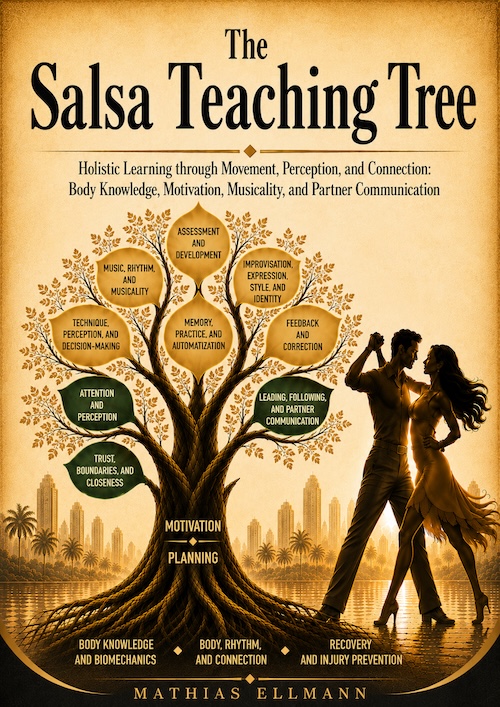
The Salsa Teaching Tree
A holistic orientation model for salsa learning and teaching that goes beyond collecting steps and figures and connects body organization, music, perception, decision-making and partner communication.
View The Salsa Teaching TreeConcept · Salsa knowledge · learning · partner communication
Mathias Ellmann

Mathias Ellmann develops the Salsa Movement Lexicon as a connection between dance technique, body knowledge, musicality, learning and partner communication.
Movement is not considered only in terms of which steps or figures are danced, but also how weight, timing, space, perception and connection interact.
Leading and following are treated as reciprocal communication: one person prepares movement possibilities and makes them perceptible, while the other responds through self-organized movement. Both roles remain perceptive, adaptive and autonomous.