Body Movement & Styling
01 · Term and function
What is Cuban Body Motion?
Coordinated response of feet, knees, pelvis, and torso to complete weight transfer; hip action emerges from loading rather than isolated pushing.
linked to pulse and weight transfer
Solo
in place · traveling · different dynamics
02 · Positions, timing and variants
Starting point, direction and variants
Timing, role context and spatial orientation are described separately. Names and execution details can vary across salsa styles, schools and regions.
Cuban motion
Body Movement & Styling
cross-style, body
linked to pulse and weight transfer
03 · Technical execution
What matters in Cuban Body Motion
Complete weight transfer between the legs is central. Foot contact, knee action, and hip action respond to loading and unloading rather than producing hip movement independently of support.
The body action is cyclical and linked to pulse and weight acceptance. Different salsa timings change step placement, not the basic dependence of the body action on actual weight transfer.
The pelvis moves three-dimensionally within an organized whole-body action; the desired hip effect is not produced through forced lumbar extension or lateral pushing.
Lower limbs, pelvis, and spine act as a coupled system. Knee and hip motion, pelvic rotation, and lateral pelvic motion influence one another.
Visible hip and torso action emerges from coordinated whole-body loading rather than being added as an isolated pelvic push.
04 · Body knowledge
What learners can notice
Weight acceptance from one leg to the other remains perceptible; pelvic movement is not produced independently of the actual supporting leg.
Knee and hip motion respond to loading and unloading and coordinate with pelvic movement.
Lateral and rotational pelvic components arise within the overall weight organization rather than as an isolated hip push.
Feet, legs, pelvis, and torso form a coupled action whose visible pathway develops from weight transfer.
05 · For beginners
Start with complete weight transfer
Practice slow alternating transfers from one leg to the other. Notice foot contact, knee, and supporting leg first; allow pelvic and torso response to emerge before increasing its size.
Does the visible pelvic action emerge with weight acceptance rather than being pushed sideways independently of it?
Do not force hip displacement or lumbar arching. Actual weight transfer matters more than producing the largest possible visible hip action.
06 · Teaching and feedback
What teachers and learners can observe
Is body weight actually and controllably accepted from one leg to the other?
Do foot, knee, and hip respond clearly to loading and unloading?
Does pelvic movement emerge from the coordination rather than as an isolated push?
Does the transition between sides remain rhythmic without abrupt joint actions?
Can range be reduced while complete weight transfer remains intact?
In Cuban Body Motion, organized weight transfer remains central; visible hip motion alone is not a sufficient quality criterion.
07 · Continue learning
From Cuban Body Motion to related movements
Oppositional organization of pelvis and ribcage that dynamically supports turns, walking actions, and partner orientation.
Segmented body wave initiated by the sternum and upper chest, followed by the ribs and torso and then the pelvis and knees. The segments reach their greatest displacement at different moments, creating a continuous wave rather than a rigid whole-body lean.
Controlled circular arm pathway through shoulder, elbow, and wrist, phrased musically while keeping the shoulder free.
Deliberate pelvic movement with a comparatively stable ribcage, without obscuring the actual weight distribution through the feet.
Deliberate shift or rotation of the ribcage while keeping the pelvis comparatively quiet, developing differentiated upper-body control and styling.
Single or alternating shoulder action performed independently from larger torso and pelvic movement.
Fast alternating shoulder isolation: one shoulder moves forward while the other moves back, then both reverse. Rib cage, pelvis and feet remain comparatively quiet so the shimmy reads as shoulder action.
Wave-like action primarily through ribcage and spine, with less pelvic involvement than a full body roll.
Coordinated gaze-and-head action in turns: the eyes remain on a reference point as long as practical and quickly reacquire it after rotation.
Additional professional background
Book on learning, body knowledge and partner communication
The movement lexicon complements The Salsa Teaching Tree by Mathias Ellmann. The book connects movement, perception and partner communication with body knowledge, motivation, musicality and sustainable learning.
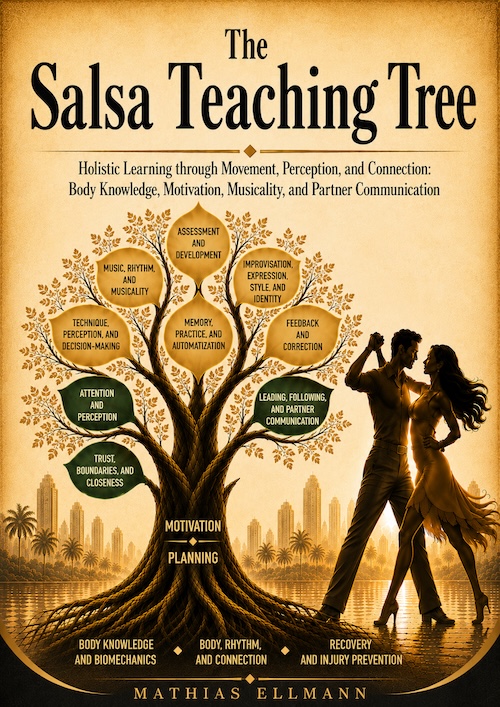
The Salsa Teaching Tree
A holistic orientation model for salsa learning and teaching that goes beyond collecting steps and figures and connects body organization, music, perception, decision-making and partner communication.
View The Salsa Teaching TreeConcept · Salsa knowledge · learning · partner communication
Mathias Ellmann

Mathias Ellmann develops the Salsa Movement Lexicon as a connection between dance technique, body knowledge, musicality, learning and partner communication.
Movement is not considered only in terms of which steps or figures are danced, but also how weight, timing, space, perception and connection interact.
Leading and following are treated as reciprocal communication: one person prepares movement possibilities and makes them perceptible, while the other responds through self-organized movement. Both roles remain perceptive, adaptive and autonomous.