Rueda Group Figure
01 · Term and function
What is Ocho?
In one Ocho sequence, after Enchufla each Lead first walks in front of the first/current Follow, then reaches the Follow to the right/downstream, passes around her back and then in front of her. He then returns to the original partner, passing around her back on the way, and finishes with Dile que no. Follows make local forward/back steps as the Lead passes behind or in front.
a-tiempo, contratiempo
Lead, Follow
a tiempo · contratiempo
02 · Positions, timing and variants
Starting point, direction and variants
In the Al Centro Ocho variant, Lead identities persist: each Lead travels in front of the first Follow, behind and in front of the next Follow, then behind the first Follow back to the home sector. The Follows remain in their circle sectors.
Eight
Rueda de Casino
rueda
a-tiempo, contratiempo
Note: Naming and exact sequencing may vary by region or school. This entry describes a widely encountered core idea and does not claim a worldwide rueda standard.
03 · Technical execution
What matters in Ocho
After Enchufla, each Lead first passes in front of the current Follow and then travels toward the Follow to the right/downstream.
The Lead passes around the back of the downstream Follow and then in front of her, keeping enough group spacing for neighboring Leads to perform the same pathway.
The Lead then returns toward the original partner and passes around her back on the way back.
Follows remain comparatively local and use forward/back steps as Leads pass behind or in front; they do not travel through the same large circuit as the Leads.
The Lead returns to the original partner and finishes the described sequence with Dile que no.
04 · Body knowledge
Body organization in Ocho
The characteristic feature of Ocho is a spatial pathway made of two connected arcs or loops. Exact role and partner organization can vary with rueda convention.
The executing dancer moves the supporting axis through the figure-eight pathway using weighted steps. Ocho is therefore more than a series of stationary turns.
When moving around neighboring positions, inside and outside pathways remain organized so dancers do not collide or pull one another apart through the arms.
05 · For beginners
Build Ocho clearly first
Walk two connected arcs around imagined positions and return in control to the intended exit.
Focus first on where the personal axis travels through space before emphasizing additional body rotation.
Viewed from above, does the pathway genuinely resemble a figure eight or double arc, and does it finish at the intended rueda position?
06 · Teaching and feedback
What to observe in a controlled Ocho
The pathway shows two connected arcs rather than nonspecific circling around several dancers.
The traveling dancer carries personal balance and does not use a partner hand as a fixed turning center.
After completion, facing direction, weight, and spacing are again clear for the next call.
07 · Continue learning
From Ocho to related movements
One Rueda variant of Adiós begins with a back-spot/circular rotation; near the end the Lead ducks under the Follow’s left arm and leaves the current partner to take the next Follow counter-clockwise.
Adiós con la Hermana or Prima con la Hermana begins without an immediate partner change. After the Adiós/Prima opening, Hermana continues as an Enchufla organization with the current Follow; in the common Rueda version the partner change occurs at the end of Hermana, followed by Dile que no.
One Cero sequence begins with Enchufla: on 5 the Lead steps back, on 6 into the circle and claps on 7. He then spins back out. The Follow duplicates the inward action next, stepping back on 1, into the circle on 2 and clapping on 3. Both return to the same partner and finish with Dile que no.
Rueda partner change: each Lead leaves the current Follow and travels downstream to the immediately next Follow; Follows largely hold their circle sectors and receive the incoming Lead. Continue with Dile que no or the next call.
Rueda partner change by two Follow positions: each Lead skips the immediately next Follow and travels to the second Follow downstream. Follows remain sector-local; the Lead must visibly traverse two slots.
Immediate repetition of Dame: the Lead who has just arrived releases the new connection again and advances one more Follow slot in the same downstream direction.
Dame to the next Follow with two claps. In one A-tiempo variant the claps fall on 7 and 8 before Dile que no; other schools place the accents differently.
Dame to the next Follow with one clap on 7 before the following Dile que no. Partner-transfer mechanics remain identical to Dame.
Enchufla enters the Al Centro/Al Medio formation. After the Enchufla the roles orient toward the circle center; Leads and Follows then alternate stepping in and back out instead of completing a normal partner-change exit.
Additional professional background
Book on learning, body knowledge and partner communication
The movement lexicon complements The Salsa Teaching Tree by Mathias Ellmann. The book connects movement, perception and partner communication with body knowledge, motivation, musicality and sustainable learning.
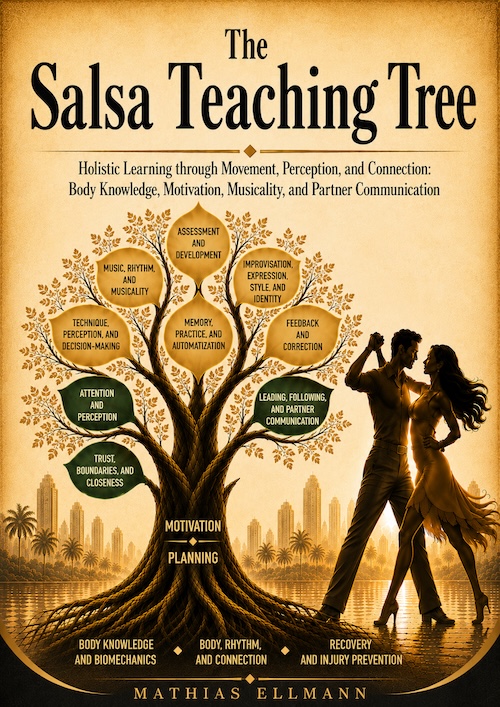
The Salsa Teaching Tree
A holistic orientation model for salsa learning and teaching that goes beyond collecting steps and figures and connects body organization, music, perception, decision-making and partner communication.
View The Salsa Teaching TreeConcept · Salsa knowledge · learning · partner communication
Mathias Ellmann

Mathias Ellmann develops the Salsa Movement Lexicon as a connection between dance technique, body knowledge, musicality, learning and partner communication.
Movement is not considered only in terms of which steps or figures are danced, but also how weight, timing, space, perception and connection interact.
Leading and following are treated as reciprocal communication: one person prepares movement possibilities and makes them perceptible, while the other responds through self-organized movement. Both roles remain perceptive, adaptive and autonomous.