Four Projects · One Overarching Artistic Progression

From Perception Through Collective Action and Dignity to Security and Autonomy

Become Visible, Built Together, Stay Upright, and The Primal Struggle are independent works. Together they form an artistic series exploring fundamental conditions of human relationships from different perspectives.

Become Visible asks when one person truly becomes visible to another. Built Together explores how perception can develop into collective action and shared responsibility. Stay Upright shifts the focus toward dignity, support, loss of control, and self-determination. The Primal Struggle carries the investigation into shared space: What happens when habit becomes a boundary and a person's sense of security is made dependent on how somebody else moves?

The Four Ballet Projects

Perceiving · Acting Together · Preserving Dignity · Remaining Autonomous

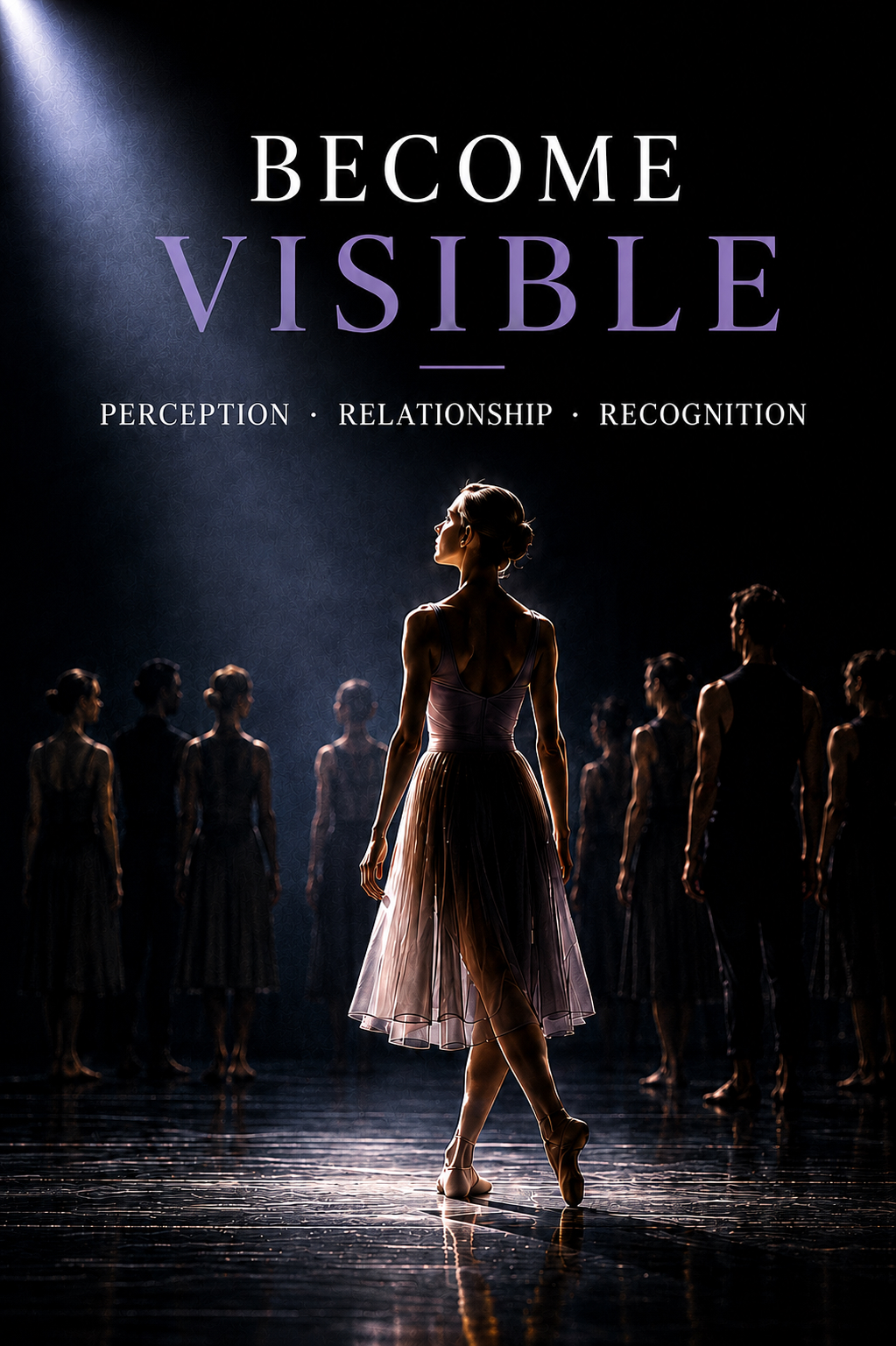
Cover of Become Visible showing a ballet figure in the light before an ensemble

Perception · Relationship · Recognition

Become Visible

A contemporary ballet project about perception, relationship, and visibility

Twelve people share the same space without initially forming a meaningful relationship with one another. Visibility begins when one person's action produces a response: a gaze, a delay, a changed path, an approach, a boundary, or support.

Seven scenes lead from non-perception through proximity, conflict, and recognition to a shared space. The final image preserves difference rather than dissolving it into uniformity or triumph.

People become visible when their presence changes the behavior of others.

Genre contemporary ballet
Duration approx. 40 minutes, no intermission
Cast 12 dancers
Structure 7 consecutive scenes
Space studio stage to mid-sized stage
Language no spoken text
  • Perception
  • Proximity and Boundaries
  • Conflict
  • Recognition
  • Visibility
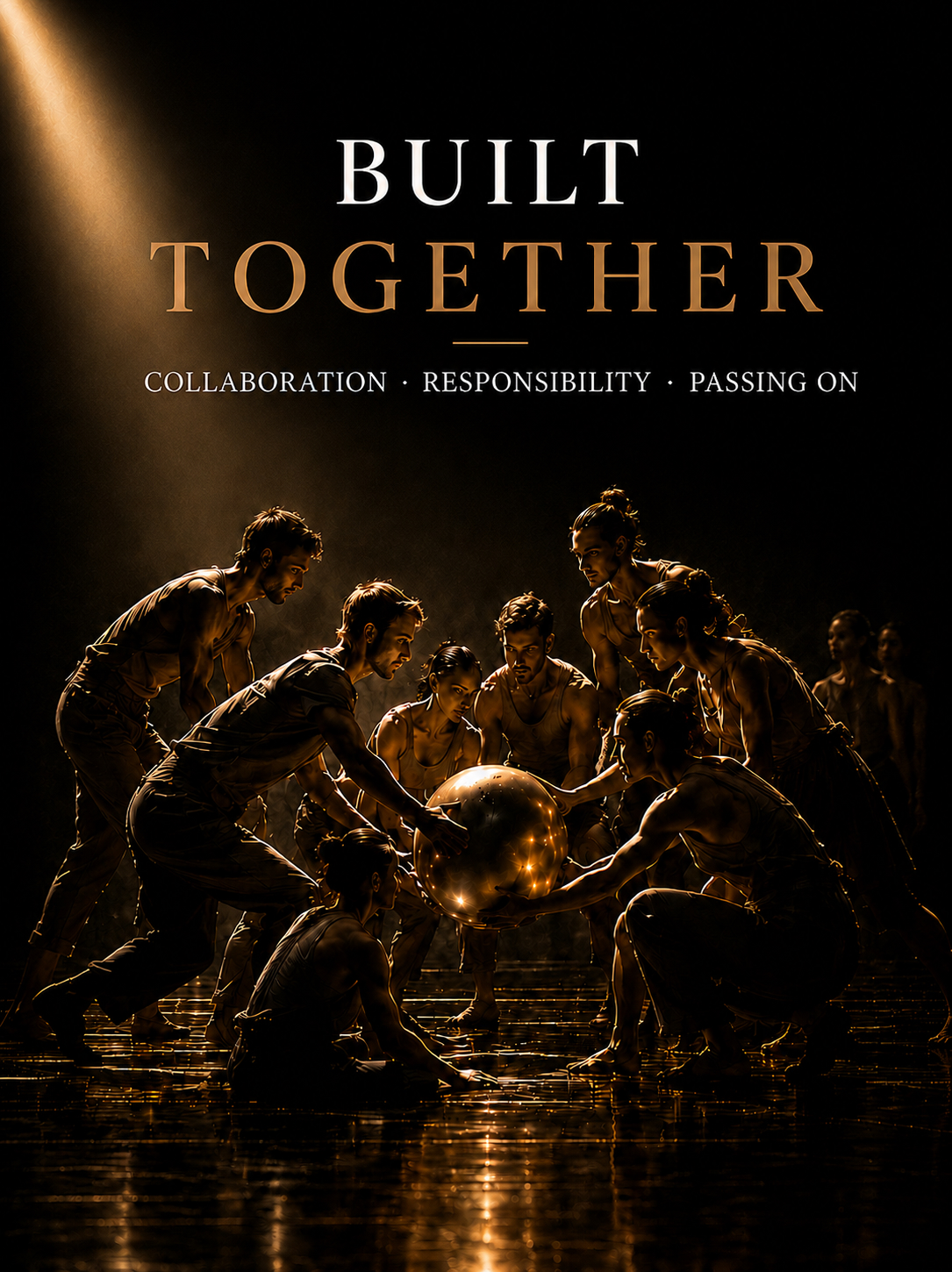
Cover of Built Together showing an ensemble gathered around a ball

Collaboration · Responsibility · Passing On

Built Together

A contemporary ballet project about collaboration, trust, and collective creation

The starting point is a single ball. Through observation, approach, handoffs, conflict, and reorientation, a shared process develops. The ensemble is the protagonist.

Responsibility does not remain with one person. It is assumed, shared, passed on, refused, and redistributed. In this way, the work reveals how a community can emerge from individual impulses without erasing difference.

What is created together is carried together and ultimately passed on.

Genre contemporary ballet / ensemble work
Duration approx. 50–55 minutes, no intermission
Cast standard version: 16 dancers; adaptable to approx. 12–24 dancers
Structure 9 consecutive scenes
Central Object a ball as the dramaturgical engine
Language nonverbal
  • Collaboration
  • Trust
  • Responsibility
  • Community
  • Passing On
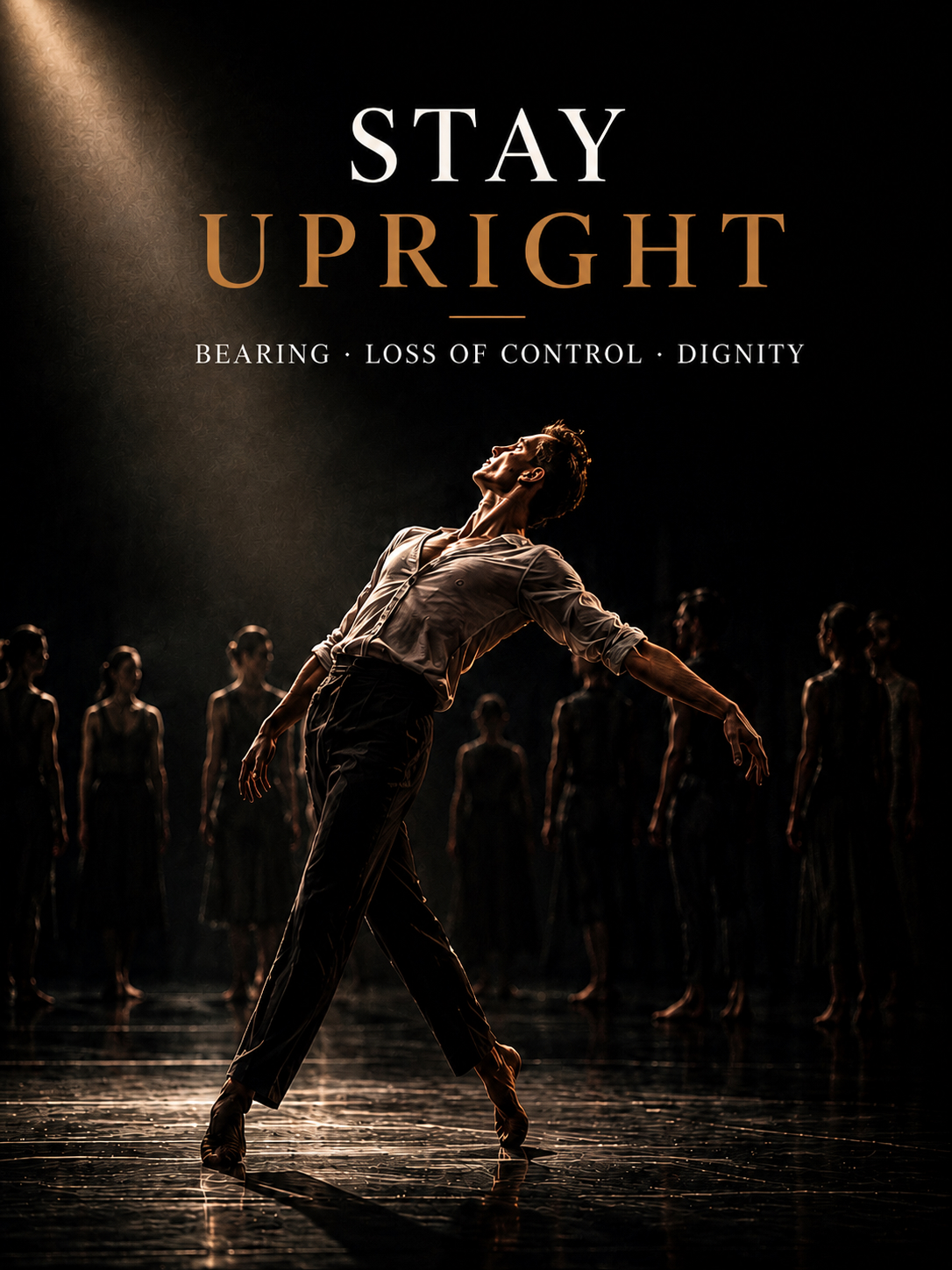
Cover of Stay Upright showing a ballet figure in a state of controlled instability

Bearing · Loss of Control · Dignity

Stay Upright

A contemporary ballet project about bearing, loss of control, dignity, and self-determination

A technically accomplished central figure gradually loses physical control. Between the ballet studio, a celebration, a bar, the public gaze, and private withdrawal, their physical stability changes, as does the behavior of the community around them.

The work asks how dignity and self-determination can endure when remaining upright is no longer a given and help can simultaneously mean support, observation, and the crossing of personal boundaries.

Dignity does not mean never losing control. It is also revealed in how a person and those around them respond to that loss.

Genre full-length contemporary ballet
Duration dependent on the final music and transition structure
Cast central figure, counterpart, and ensemble; approx. 14 performers recommended, adaptable
Structure 9 consecutive scenes
Language nonverbal
Distinctive Feature controlled instability and costume dramaturgy
  • Bearing
  • Loss of Control
  • Public Gaze
  • Help and Boundaries
  • Dignity
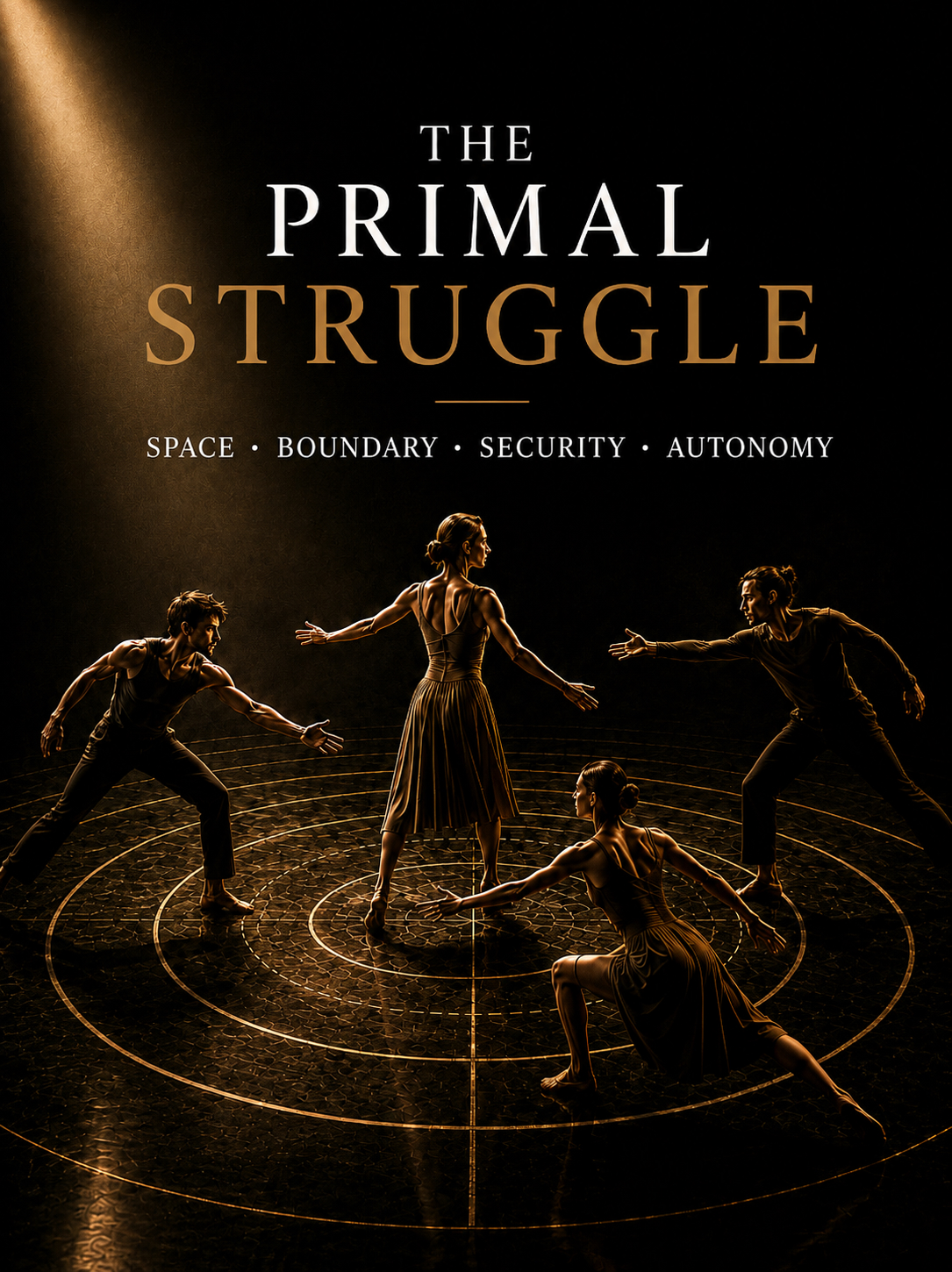
Cover of The Primal Struggle showing four figures within a circular spatial arrangement

Space · Boundary · Security · Autonomy

The Primal Struggle

A contemporary ballet about space, boundary, security, autonomy, self-respect, and the emergence of conflict

Four people use the same stage space. Repeated pathways create habit, orientation, and predictability even though there is no visible boundary line and no explicit claim of ownership. Only a changed route reveals that repeated use of the space has long since created an expectation.

From perception emerge boundaries, requests, demands, control, and counter-control. The work presents no winner. At the end, the previously closed spatial arrangements open; four autonomous people retain their own pathways, directions, and decisions within the same shared space.

Shared space becomes possible without forcing one another into reactive behavior.

Genre contemporary ballet
Duration approx. 20 minutes, no intermission
Cast 4 dancers
Structure 8 consecutive scenes
Performance Area ideally approx. 12 × 10 m; minimum approx. 10 × 8 m
Technique classical ballet used in a contemporary context
  • Space
  • Boundary
  • Security
  • Autonomy
  • Self-Respect

Choreographic Signature

Choreography of Relationship

Mathias Ellmann uses classical ballet technique as a precise language of human relationships. His choreographic signature is the choreography of relationship. What connects the four works is not a recurring pose or step sequence, but a choreographic way of thinking: What changes between people when one person moves?

Direction, distance, speed, gaze, timing, and response change the possibilities available to other bodies. Gaze, distance, approach, spatial pathways, and boundaries make relationships visible. Handoffs and partner changes organize collective action. Alignment, shifts of weight, and contact negotiate support and self-determination. Radius, direction, blocking, evasion, response, and non-response reveal how possibilities for action between people can be expanded or restricted.

Dramaturgical and Pedagogical Legibility

Four Independent Development Arcs – One Deepening Exploration of Human Relationships

The four projects do not tell one continuous story. Their sequence nevertheless makes an overarching progression legible: Become Visible begins with perception and recognition. Built Together develops this into collective action and shared responsibility. Stay Upright carries the question into support, self-determination, and dignity. The Primal Struggle finally explores how security and autonomy can exist within a shared space without turning into control over another person's movement.

What happens? The observable physical or spatial event.
What does it represent? Its dramaturgical or interpersonal meaning.
What changes? Feeling, need, relationship, or responsibility.
Why is it important? The function of the phase within the overall arc of the work.

01 · Become Visible · 7 Scenes

From Non-Perception to Recognition and Shared Space

Twelve people occupy the same space without initially forming a meaningful relationship with one another. Visibility does not arise simply because a person moves into the center, but because others respond to their presence. Proximity, boundaries, and conflict therefore belong to the work just as much as recognition does.

Development Arc: Non-perception → first response → approach → proximity and boundaries → conflict → recognition → shared space
Scenic Development Arc of Become Visible
Scene What happens? What does it represent? Feeling / Need Why is it important?
1. Non-Perception Twelve people share the same space but move largely independently. Presence without relationship. Distance; needs for perception, recognition, and belonging. Spatial proximity alone does not create human connection.
2. First Response A gaze, delay, or change of direction responds for the first time to another person's movement. Attention and first mutual relevance. Curiosity, tension; orientation and recognition. A person becomes visible because their behavior produces a response.
3. Approach Pathways, gazes, and movements increasingly relate to one another. Interest and emerging relationship. Proximity, trust, belonging. Relationship emerges through repeated mutual attention.
4. Proximity and Boundaries Contact is offered, accepted, delayed, or refused. Relationship contains both proximity and personal boundaries. Proximity and autonomy. Proximity is not equated with harmony; a boundary remains a legible form of relationship.
5. Conflict Different movement intentions meet one another. Difference and conflicting needs. Respect, autonomy, understanding. Perceiving another person does not mean people must want the same thing.
6. Recognition One person perceives another person's boundary or decision and changes their own behavior. Recognition without making people identical. Respect, appreciation, acceptance. A relationship can continue without requiring the other person to change.
7. Shared Space Everyone remains distinguishable while consciously sharing the same space. Belonging without uniformity. Community, recognition, integrity. The final image preserves difference.

02 · Built Together · 9 Scenes

From Perception to Collective Action and Shared Responsibility

The ensemble is the protagonist. A ball sets a social and choreographic process in motion. Perception develops into approach, structure, and collaboration. A crisis forces the group to redistribute responsibility.

Development Arc: Task → approach → order → collaboration → crisis → reorientation → shared carrying → completion → passing on
Scenic Development Arc of Built Together
Scene What happens? What does it represent? Feeling / Need Why is it important?
1. The Task A ball is perceived; sightlines and pathways begin to change. A shared task appears. Orientation, meaning, clarity. Collective action begins with perception, not with an immediate solution.
2. The Approach First responses, handoffs, and relationships emerge. The beginning of participation and responsibility. Belonging and participation. Individual perception becomes the first form of shared action.
3. The Order Repeatable sequences, spatial pathways, and temporary roles emerge. Structure and collective organization. Order, reliability, orientation. Collaboration requires structures without rigid hierarchy.
4. The Movement The ball, partner changes, and spatial pathways increasingly flow with confidence. Functioning collaboration. Trust, effectiveness, community. Coordinated differences create a shared form.
5. The Obstacle The previously functioning sequence is disrupted. A crisis within the shared system. Understanding, security, reliability. The disruption reveals whether collaboration is adaptable.
6. The Reorientation Roles, pathways, and partnerships are changed. Learning capacity and redistribution of responsibility. Autonomy, development, responsibility. The group develops a new order rather than returning to the old one.
7. Shared Carrying Responsibility and weight are carried by several people. Interdependence and shared responsibility. Trust, support, community. Responsibility becomes physically visible as a shared function.
8. The Completion The group reaches a shared, stable configuration. Recognition of what has been created together. Meaning, recognition, community. The process reaches a visible, provisional completion.
9. The New Beginning What has been created is passed on. Future and openness. Development, meaning, responsibility. The work ends with passing on rather than possession or triumph.

03 · Stay Upright · 9 Scenes

From Control and Facade to Help, Boundaries, and a New Bearing

Responsibility now concerns not only a shared task, but a person whose accustomed physical and social security becomes fragile. This creates the more difficult question of when support helps, when it becomes control, and how self-determination can be preserved.

Development Arc: Control → opening → first deviation → assertion → loss of control → public gaze → withdrawal → help and boundaries → new bearing
Scenic Development Arc of Stay Upright
Scene What happens? What does it represent? Feeling / Need Why is it important?
1. The Perfect Order Body, space, and ensemble function precisely. Technique, order, and security. Self-confidence, self-respect, orientation. The initial state makes later deviations legible.
2. The Celebration Contact, dynamics, and social interaction increase. Vitality and a gradual loosening of restraint. Belonging, joy, recognition. Change does not initially appear as a crisis.
3. The Bar Small uncertainties become visible; the central figure corrects posture and presentation. Facade and the social gaze. Recognition, security, self-respect. Inner state and outward image begin to diverge.
4. The Assertion Control is defended more actively and visibly. Self-assertion and protection of the public image. Self-respect, recognition, control. The less reliable control becomes, the greater the effort required to maintain it.
5. The Loss of Control Instability becomes unmistakable; corrections no longer function reliably. Vulnerability and the limits of physical control. Security, protection, dignity. The central physical turning point.
6. The Public Gaze The ensemble directs its attention toward the central figure. Physical uncertainty becomes a social event. Respect, belonging, orientation. Dignity also depends on the behavior of those around us.
7. At Home The public situation disappears; movement becomes smaller and more private. Private vulnerability without a facade. Rest, protection, self-awareness. The person is separated from their public role.
8. Help and Boundaries Support is offered, refused, later initiated by the central figure, and finally shared. The relationship between help, autonomy, and trust. Self-determination, support, trust. Help is not automatically beneficial; the decision of the person being supported remains decisive.
9. A New Bearing Difference and relationship exist simultaneously. Dignity without restoring former perfection. Dignity, trust, belonging. The work ends with a changed understanding of uprightness and stability.

04 · The Primal Struggle · 8 Scenes

From Habit and Boundary Through Mutual Control to Open, Independent Pathways

Four people use the same space. Repeated pathways initially create familiarity and predictability. A changed route reveals that habit has become a conscious expectation and begins to function as a boundary. The conflict intensifies where another person's movement becomes a condition of one's own security or self-respect.

Development Arc: Habit → perception → boundary → crossing → demand → control → mutual dependence → opening
Scenic Development Arc of The Primal Struggle
Scene What happens? What does it represent? Feeling / Need Why is it important?
1. The Land Repeated pathways form familiar spatial arrangements. Habit creates orientation and predictability. Order, autonomy, belonging. The later boundary becomes legible only because a stable order exists first.
2. The Unfamiliar Stimulus A change is perceived; gaze and pathways respond to it for the first time. Taken-for-granted habit becomes conscious expectation. Orientation, security, autonomy. The other person acquires spatial significance.
3. The Crossing A figure leaves the familiar pathway and enters a space treated differently by another. An invisible boundary takes effect through behavior. Security, autonomy, orientation. It is not the crossing alone, but the response to it, that determines what follows.
4. Warning, Request, Demand Irritation develops into request, demand, and increasing pressure. Protecting one's own space begins to turn into influence over another person's movement. Security, respect, autonomy. A legitimate need becomes linked to a controlling strategy.
5. The Circle Becomes an Arena Blocking and counter-blocking intensify the spatial relationship. Resistance develops into mutual control. Autonomy, self-respect, security. The conflict increasingly separates itself from its original cause.
6. The Mirror Fight Both sides respond more immediately to one another and intensify their movements. Influence becomes mutual dependence. Self-respect, recognition, autonomy. The more both sides try to influence the other, the smaller their own room for independent decision-making becomes.
7. What Are We Still Defending? The conflict movement diminishes. Other figures cross the former boundary without triggering a new fight. Boundary and conflict can be separated from one another. Calm, orientation, autonomy. Perception no longer has to produce an automatic counter-response.
8. The New Order Familiar impulses remain perceptible but no longer automatically trigger the expected counter-movement. The pathways open. Shared space without fusion and without a winner. Security, respect, autonomy. Difference does not disappear; what disappears is the need to answer difference through mutual control.

Shared Artistic Throughline

The four works are independent, but they can be read through a shared progression of human relationships.

01 · Become Visible: Perception and recognition – How do I perceive another person?

02 · Built Together: Collaboration and responsibility – How do I act together with others?

03 · Stay Upright: Dignity, help, and self-determination – How do I support another person without taking over?

04 · The Primal Struggle: Security, boundary, and autonomy – How do we remain autonomous while sharing the same space?

Overarching Progression: Perception → Collaboration → Dignity → Autonomy.

Project Status and Materials

Developed · Ready for Rehearsal · Adaptable

The dramaturgical and choreographic structures of all four works are developed. The specific stage version is created with the respective ensemble. Depending on the project, available materials include short and detailed project proposals, audience guides, production and staging documentation, dramaturgical and scenic scores, movement principles, character and ensemble logic, spatial and stage structures, lighting and music dramaturgy, rehearsal planning, technical procedures, stage-management documentation, and program and press texts.

A complete English-language project dossier covering all four works is available. More extensive project-specific production and staging documentation is currently primarily available in German. Further English-language materials can be prepared in connection with a specific international collaboration.

Materials Available Depending on the Project

  • short and detailed project proposals
  • audience guides
  • production and staging documentation
  • dramaturgical and scenic scores
  • movement principles and character logic
  • spatial and stage structures
  • lighting and music dramaturgy
  • rehearsal and production planning
  • technical procedures and stage-management documentation
  • program, press, and audience-engagement texts

Commission

Work Development with an Ensemble

Rehearsal, ensemble-specific adaptation, and refinement of a selected work within a professional rehearsal process.

Co-Production

Joint Artistic Production

Joint coordination of choreography, dramaturgy, music, lighting, costume, production, and financing.

Residency

Studio and Stage Exploration

Studio and stage exploration, adaptation to the space, work on partnering dynamics, technical coordination, and development of a specific stage version.

Stage Production

A Version for the Specific Venue

Adaptation to ensemble size, stage space, and production framework while preserving the dramaturgical core.

Artistic Collaboration

Assistance, Rehearsal, and Ensemble Development

Collaboration with artistic assistants, rehearsal directors, répétiteurs, and experienced dancers.

Festival or Studio

Condensed Version

A condensed version can be developed provided that the structure of the work, its artistic core, and its dramaturgical logic are preserved.

Audience and Engagement Potential

Artistic Accessibility Without Simplification

Dance and Theater Audiences

The projects combine precise choreographic structures with physically legible relationships in space. The series offers an additional point of access through four fundamental questions of human relationships.

Ensemble and Engagement

The works can be translated directly into rehearsal questions: Do I perceive the others? How does my action change the group? When does support help? When does my own need begin to restrict another person's possibilities for action?

International Contexts

The nonverbal form allows for different cultural readings and for productions without spoken text.

Accompanying Formats

Possible formats include introductions, audience discussions, workshops, open rehearsals, and moderated post-show conversations.

Choreography and Concept

Mathias Ellmann

Mathias Ellmann

Mathias Ellmann develops choreographic and dramaturgical concepts for contemporary ballet works. He uses classical ballet technique as a precise language of human relationships. At the center of his choreographic work is the question: What changes between people when one person moves?

The four projects Become Visible, Built Together, Stay Upright, and The Primal Struggle form an artistic progression from perception through collaboration and dignity to security and autonomy.

At the center are observable relational processes: gaze, distance, approach, handoff, weight shift, boundary, support, response, and changes in shared space. Movement is not treated only as individual action, but as something that changes the possibilities available to another person.

Additional Professional Background

In addition to his choreographic work, Mathias Ellmann develops publications and models on body knowledge, motivation, self-respect, and artistic learning in ballet. These include The Ballet Teaching Tree and Leni and Oscar and the Secret of the Ballet Tree.

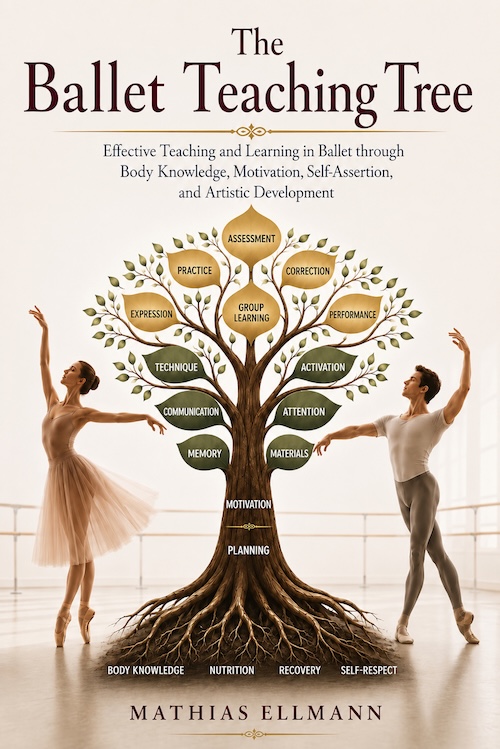
Book cover of The Ballet Teaching Tree by Mathias Ellmann

The Ballet Teaching Tree

Effective teaching and learning in ballet through body knowledge, motivation, self-assertion, and artistic development. The book connects physical foundations, lesson planning, learning psychology, technique, communication, correction, artistic expression, and evaluation.

View The Ballet Teaching Tree
Book cover of Leni and Oscar and the Secret of the Ballet Tree by Mathias Ellmann

Leni and Oscar and the Secret of the Ballet Tree

A children's book about body awareness, courage, self-respect, patience, and the joy of learning step by step. The story makes central ideas of the Ballet Tree accessible through movement, mistakes, feelings, correction, and growth.

View the Children's Book

The relationship between The Ballet Teaching Tree and Leni and Oscar and the Secret of the Ballet Tree, as well as their shared educational model, is presented in more detail on the joint book page.

Frequently Asked Questions

Questions About the Series, Materials, and Collaboration

Do the four works form a continuous tetralogy?

No. The four works are independent and do not tell one continuous story. They can nevertheless be read as a shared artistic series: perception and recognition, collaboration and responsibility, dignity and self-determination, and boundaries, security, and autonomy.

Why are the works presented in the order Become Visible, Built Together, Stay Upright, and The Primal Struggle?

The sequence follows a deepening exploration of human relationships. It first asks when another person is perceived and recognized at all. Collective action can then emerge from perception. The question of help, dignity, and self-determination subsequently becomes more concrete. The Primal Struggle carries this progression into shared space and explores the point at which security and boundaries begin to turn into control over others.

What does The Primal Struggle explore?

The work begins with four people and repeated spatial arrangements. A changed route reveals that repeated use of the space has long since created an expectation. An invisible boundary takes effect through behavior. From this emerge requests, demands, control, and counter-control. The ending presents no winner, but four independent pathways within a reopened shared space.

For which partners are the ballet projects intended?

The projects are intended for theaters, professional ballet and dance companies, festivals, production houses, co-production partners, and funding organizations. Conversations with artistic assistants, rehearsal directors, répétiteurs, and experienced dancers are also welcome.

What materials are available for the projects?

A complete English-language project dossier covering all four works is available. Depending on the project, further materials include short and detailed project proposals, audience guides, production and staging documentation, dramaturgical and scenic scores, movement principles, character and ensemble logic, spatial, lighting, and music concepts, rehearsal planning, and technical procedures. More extensive project-specific production documentation is currently primarily available in German.

Are the projects completely fixed?

The artistic, dramaturgical, and choreographic structures are developed. The specific performance version is rehearsed with the respective ensemble and adapted to the cast, space, and production framework while preserving the core of the work.

Why are the complete production and staging materials not publicly available?

The materials contain extensive artistic, choreographic, dramaturgical, and production-related development. They are therefore provided selectively after personal discussion when there is specific interest.

Are the projects suitable for international collaboration?

The projects are conceived as nonverbal works. Their themes are communicated through the body, movement, space, gaze, contact, music, and light, making them suitable for international ensembles and festivals.

Are all project materials available in English?

A complete English-language project dossier covering all four works is available. More extensive project-specific production and staging documentation is currently primarily available in German. Further English-language materials can be prepared in connection with a specific international collaboration.

What is the purpose of the development arcs shown here?

The development arcs explain the dramaturgical function of consecutive phases: what changes physically, what relationship becomes visible, and why that change is necessary for the further development of the work. Detailed choreographic sequences remain part of the project-specific production and staging materials.

Collaboration

Inquiries from Theaters, Companies, Festivals, Production Partners, and Artistic Collaborators

An initial conversation can identify the appropriate project, the artistic framework, and the most suitable form of collaboration. More detailed materials can then be provided as appropriate. Inquiries from experienced artistic assistants, rehearsal directors, répétiteurs, and dancers interested in future rehearsal and staging processes are also welcome.

Full Cover