Leni and Oscar and the Mystery of the Quiet Voice
Another story with Leni and Oscar about perception, courage, communication, and the importance of a quiet voice.
A children’s book about body awareness, courage, and the joy of learning
by Mathias Ellmann
ISBN: 978-3-6952-6258-8
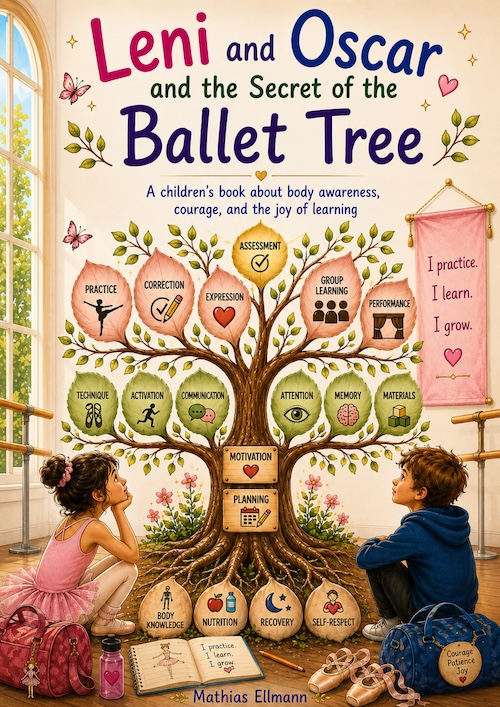
Learning sometimes looks like a jump. Sometimes like a turn. And sometimes like a tree: with roots, a trunk, branches, leaves, and a summit that shows how growth becomes visible.
Leni and Oscar and the Secret of the Ballet Tree is a literary children’s story about ballet, body knowledge, self-respect, patience, and the joy of learning step by step.
At the center are Leni and Oscar, who discover a special tree in a ballet studio. The Ballet Tree shows them that dancing is not only made of technique, turns, or jumps. Learning needs roots, a supporting trunk, living branches, growing leaves, and the question of what has truly been understood.
The book is aimed at elementary school children as well as parents, teachers, dance educators, ballet schools, music and movement schools, libraries, families, and everyone who supports children in learning, practicing, and growing.
The book is suitable for children, families, ballet schools, educational institutions, libraries, and everyone who understands learning as an attentive process of growth.
| Title | Leni and Oscar and the Secret of the Ballet Tree |
|---|---|
| Subtitle | A children’s book about body awareness, courage, and the joy of learning |
| Author | Mathias Ellmann |
| Format | eBook |
| ISBN | 978-3-6952-6258-8 |
Why learning may grow like a tree: with roots, trunk, branches, leaves, and time.
How children learn not to fight their bodies, but to perceive them attentively.
Why dancing and learning can only grow healthily when children are allowed to respect themselves.
How children discover that ability does not have to appear immediately, but grows step by step.
How repetition, attention, and helpful corrections can make learning clearer.
Why ballet is not practiced only alone, but also through listening, observing, and working with others.
Leni notices subtle signs. She sees when someone becomes unsure, when a correction hurts, or when a child wants to trust themselves more than they can say out loud.
Oscar wants to begin immediately. He wants to jump, turn, and show that he is brave. But in the ballet studio he learns that courage also needs patience.
Mila is careful and sometimes unsure. Her development shows that self-respect and quiet clarity are important roots of learning.
Finn often covers uncertainty with jokes. Step by step, he learns that words can help, but they can also press on others.
Ms. Celeste accompanies the children in the ballet studio. She shows them that correction does not have to shame, and that learning begins with the body.
The children do not only learn individually, but together: through observation, consideration, shared practice, and mutual encouragement.
The book presents ballet not as a display of performance, but as a learning space. Children discover that technique, expression, and practice matter, but not without body knowledge, recovery, self-respect, motivation, and patience.
This makes the story suitable as a discussion starter for body awareness, healthy learning processes, dance education, self-respect, dealing with correction, motivation, group learning, and the question of how children can grow without losing themselves.
A book that opens conversations about learning, practice, body awareness, pressure, and patience.
A narrative approach to learning motivation, self-respect, error culture, and development.
A story about how dancing grows through body knowledge, attention, and joy.
Another story with Leni and Oscar about perception, courage, communication, and the importance of a quiet voice.
Leni und Oskar und das Geheimnis des Ballettbaums ist auch auf Deutsch erhältlich.
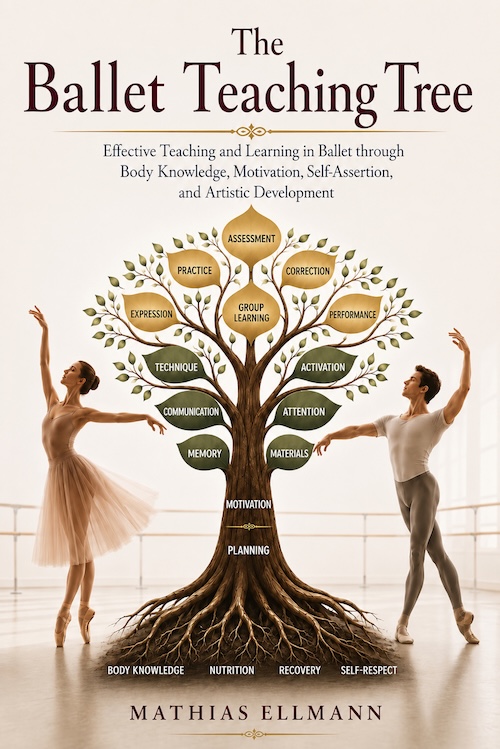
This specialist book explores the educational and methodological foundations of the Ballet Tree for teaching, training, and guided learning.
The book tells the story of Leni and Oscar, who discover a special tree in a ballet studio. The Ballet Tree shows them that learning in dance consists of many parts: body knowledge, self-respect, planning, motivation, technique, correction, expression, group learning, and assessment.
The book is especially suitable for elementary school children as well as parents, teachers, dance educators, ballet schools, libraries, and everyone who supports children in learning and growing.
Central themes include body awareness, courage, self-respect, ballet learning, body knowledge, nutrition, recovery, motivation, planning, technique, communication, attention, practice, correction, expression, and group learning.
The Ballet Tree is a narrative model for learning in ballet. Its roots stand for body knowledge, nutrition, recovery, and self-respect. The trunk stands for planning and motivation. The branches and leaves show how technique, practice, correction, expression, and shared learning can grow.
No. The story takes place in a ballet studio, but it addresses general questions of learning: How do I deal with mistakes? How do I listen to my body? How do I stay motivated? How can I grow without overwhelming myself?
The central message is: Learning does not have to begin perfectly. It may grow. Children may practice, make mistakes, respect their bodies, need breaks, and develop joy in learning step by step.
The contents of the book can be presented as a reading, book presentation, school event, library format, parent evening, or educational impulse.
The focus is on body awareness, courage, self-respect, healthy learning processes, dance education, correction, motivation, and the question of how children can learn without going against themselves.