Judgement
Evaluate observations critically
Data and technical outputs are not equated with reality. Assumptions, interpretations, uncertainty and possible reasoning errors are made visible.

Technical books · Data Science · Machine Learning · Software Engineering
Four independent technical books connect critical thinking, Data Science and Machine Learning with Python, and Software Engineering with Java.
Technical tools do not create responsible solutions on their own. Data, models, Python, Java and program code support processes of inquiry and decision-making. Problem understanding, evaluation, trade-offs and responsibility remain human tasks.
Common subject framework
The four titles were not published as a continuing book series. They are independent technical books, but they share a clear thematic connection: each examines a different stage or perspective of responsible technical problem-solving.
The common path begins with the critical examination of observations and assumptions. It continues through data quality, analysis and modelling to decisions, requirements, software architecture, implementation, testing and operation.
Clarify observations, terms, goals and context.
Examine quality, provenance, assumptions and constraints.
Compare predictions, metrics, risks and options.
Weigh uncertainty, trade-offs and consequences.
Design architecture, code and tests for long-term use.
Secure maintainability, monitoring and human accountability.
Relevance for study and professional practice
Technical projects do not fail only because knowledge about algorithms or programming languages is missing. Difficulties often arise earlier: unclear questions, unchecked assumptions, inadequate data, unsuitable metrics, conflicting requirements or solutions that are selected too early.
Judgement
Data and technical outputs are not equated with reality. Assumptions, interpretations, uncertainty and possible reasoning errors are made visible.
Data practice
Problem definition, data quality, analysis, reproducibility, communication and practical use are treated as one connected process.
Model evaluation
Models support decisions. They do not replace expert judgement or the evaluation of error costs, fairness, explainability and consequences.
Software quality
Working code is only one part of a solution. Requirements, architecture, testing, maintainability and operation determine whether it remains viable over time.
The four technical books
Each book has its own focus and can be read independently. Together, the four titles provide a broader view of problem understanding, data, models, decisions, software development and responsibility.
Critical Thinking · Data Science · Python
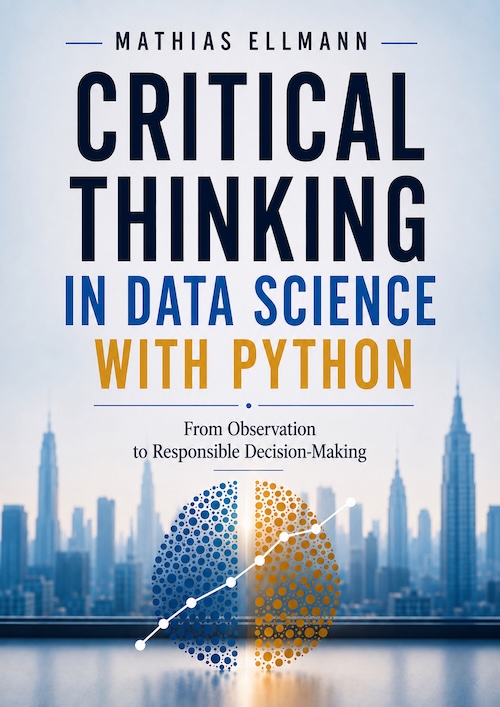
From Observation to Responsible Decision-Making
German edition title: Kritisches Denken in Data Science mit Python
This book develops the epistemological and argumentative foundations of critical Data Science. It examines observations, assumptions, hypotheses, uncertainty, evidence, argumentation and responsible decisions.
Data Science · Python
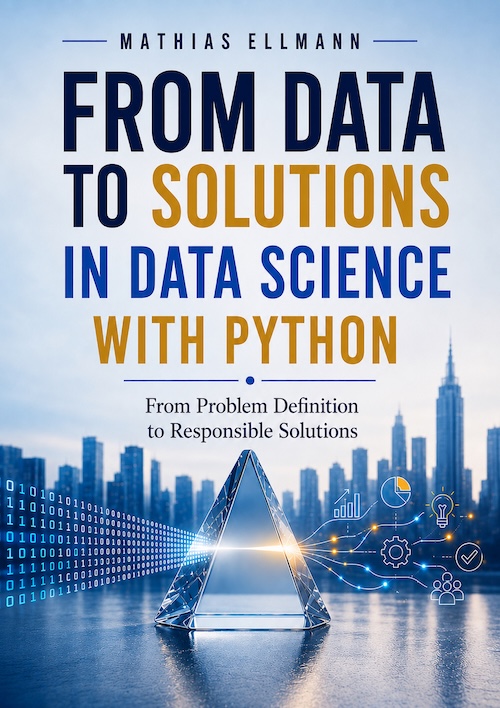
From Problem to Responsible Solution
German edition title: Von Daten zu Lösungen in Data Science mit Python
This book applies critical thinking to the complete Data Science process: from problem definition and data quality to analysis, modelling, deployment, monitoring and communication.
Machine Learning · Python
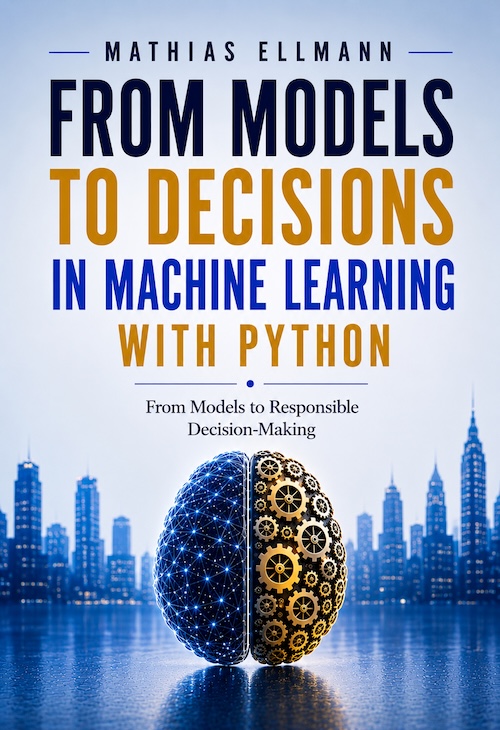
From Model to Responsible Decision-Making
German edition title: Von Modellen zu Entscheidungen in Machine Learning mit Python
This book focuses on the transition from Machine Learning models to human decisions. Predictions are assessed in relation to metrics, uncertainty, error costs, fairness, robustness and explainability.
Software Engineering · Java
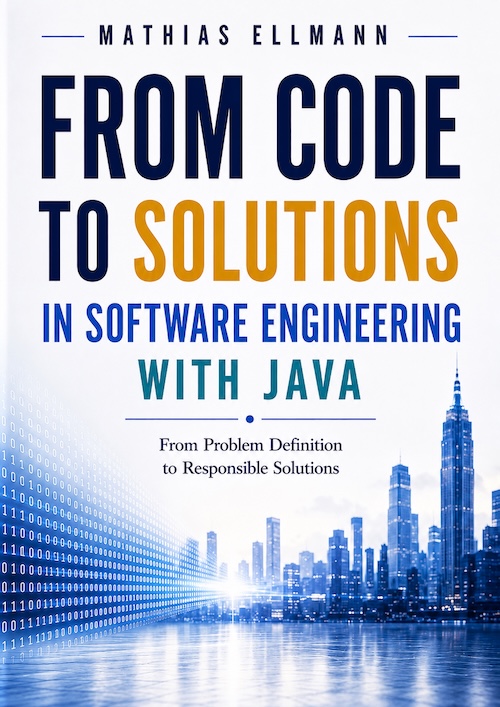
From Problem to Responsible Solution
German edition title: Von Code zu Lösungen im Software Engineering mit Java
This book transfers the problem-solving and responsibility-oriented approach to Software Engineering. Requirements, architecture, implementation, testing, operation and maintainability are treated as connected decisions.
Intended readers
Study and entry level
For readers who want to connect technical foundations with critical thinking, problem understanding and responsible use rather than learning isolated tools.
Data practice
For projects in which data quality, model performance, uncertainty, reproducibility and communication must be considered together.
Machine Learning
For the responsible interpretation of predictions, metrics, error costs, fairness, explainability and human accountability.
Software development
For translating business problems and requirements into testable, maintainable and sustainably operable software systems.
Education
As a basis for courses, seminars, exercises, workshops and discussions about technology, quality and responsibility.
Project responsibility
For the structured clarification of goals, stakeholders, alternatives, risks, requirements and the long-term consequences of technical decisions.
The books teach general ways of thinking and working. They do not replace domain-specific analysis, legal review, security assessment or concrete project planning.
Shared competencies
Distinguish symptoms, causes, goals, constraints and stakeholder interests.
Examine data provenance, quality, representativeness, uncertainty and possible distortion.
Understand models as simplifications and avoid equating their outputs with reality or decisions.
Compare baselines, non-technical options, models and architectures using transparent criteria.
Treat requirements, architecture, testing, maintainability and operation as connected parts of a viable solution.
Justify decisions, communicate uncertainty and consider the effects of technical systems on affected people.
Frequently asked questions
No. The four titles were published as independent technical books. They are, however, closely related in content because they examine different perspectives on the same underlying process of responsible technical problem-solving.
Each book can be read independently. For a continuous learning path, a useful order is critical thinking, Data Science, Machine Learning and Software Engineering.
The books are intended for students, learners, educators and practitioners in Data Science, Machine Learning and software development, as well as project owners who need to assess technical results and use them responsibly.
The books on Data Science and Machine Learning use Python. The book on Software Engineering uses Java.
The focus is not limited to syntax and tools. The books also address problem definition, data and requirements quality, assumptions, model evaluation, alternatives, communication, operation and human responsibility.
No. Readers can select the title that matches their main area of interest. The common framework becomes especially clear when several books are combined.
For workshops, seminars, courses, professional discussions or questions about individual books, you can get in touch by phone or email. Content, target audience, duration and fees are agreed in advance.
Please send sensitive or confidential documents only through a secure transmission channel agreed in advance. Time-critical deadlines are considered accepted only after explicit confirmation.