Software Engineering as Problem Solving
Why good software does not begin with code, but with a clearly understood problem, explicit objectives, and an appropriate decision context.
From Problem Definition to Responsible Solutions
by Mathias Ellmann
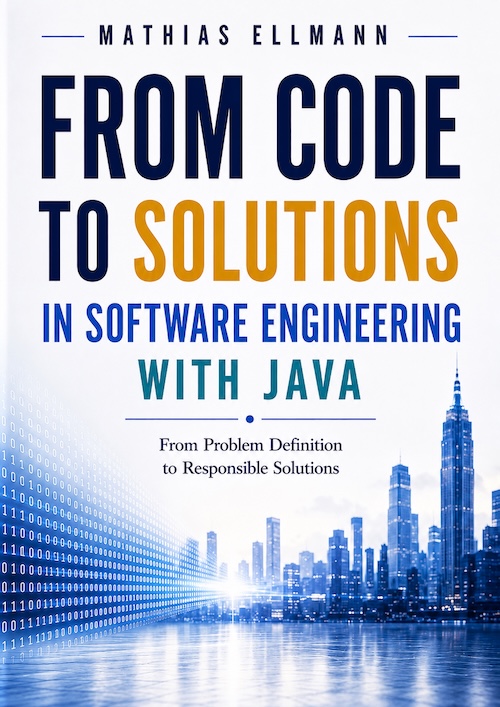
Software engineering is often reduced to programming languages, frameworks, and code. Yet viable software does not emerge from code alone. It requires the ability to understand problems, clarify requirements, develop models, justify architectural decisions, manage uncertainty, and create quality systematically.
From Code to Solutions in Software Engineering with Java explains how problems, requirements, models, alternatives, and decisions can be transformed into viable, understandable, and responsible software solutions.
The book covers software projects, stakeholders, requirements, domain models, object models, architecture, alternatives, risks, Java, object orientation, interfaces, persistence, quality, testing, debugging, refactoring, technical debt, deployment, monitoring, communication, security, data protection, fairness, and responsible decision-making in software engineering.
The book is intended for students, educators, Java learners, aspiring software developers, practitioners, software engineering beginners, project teams, software architects, technical project leads, managers, decision-makers, and technically interested readers who want to understand software development as more than programming.
No extensive experience in software engineering is required. Basic programming knowledge is helpful, but the central concepts are developed from their motivation, practical relevance, and role within responsible problem solving.
From Code to Solutions in Software Engineering with Java is available as an eBook from Amazon Kindle. Additional retailer links will be added as soon as they are available.
| ISBN | 978-3-6952-6336-3 |
|---|---|
| Format | eBook |
| Publisher | BookRix |
Why good software does not begin with code, but with a clearly understood problem, explicit objectives, and an appropriate decision context.
How stakeholder perspectives, assumptions, functional and non-functional requirements, quality objectives, conflicts, and uncertainty can be identified and structured.
How domain models, object models, architecture models, alternatives, risk analysis, trade-offs, and decision records help make complexity manageable.
How classes, objects, relationships, interfaces, data structures, error handling, persistence, and applications can be understood as deliberate design decisions.
Why quality is created continuously through clear architecture, testing, debugging, maintainability, refactoring, and conscious management of technical debt.
How deployment, monitoring, DevOps, communication, security, data protection, fairness, traceability, and long-term responsibility form part of a complete software solution.
An English-language presentation accompanying From Code to Solutions in Software Engineering with Java is currently being prepared.
The presentation will provide a concise introduction to the central path of the book: from problem understanding, stakeholders, and requirements through models, architecture, Java, implementation, quality, operation, communication, and responsibility.
Once available, the presentation will be viewable directly in the browser and downloadable as a PDF.
Yes. The book covers Java, but it does not treat the language in isolation. It presents Java as a tool for software engineering, problem solving, requirements, modeling, architecture, quality, and responsible software development.
Yes. The book is suitable for students, Java learners, aspiring software developers, practitioners, and technically interested readers. No extensive software engineering experience is required, although basic programming knowledge is helpful.
The book covers problems, stakeholders, requirements, models, architecture, alternatives, risks, quality objectives, trade-offs, Java, object orientation, data structures, error handling, persistence, interfaces, testing, debugging, refactoring, technical debt, deployment, monitoring, communication, security, data protection, fairness, and responsibility.
Yes. A central focus is the path from problem understanding and stakeholder analysis through requirements, domain models, object models, architecture models, alternatives, and justified architectural decisions.
Yes. It explains classes, objects, state, behavior, encapsulation, relationships, inheritance, interfaces, data structures, error handling, persistence, and application development with Java.
Yes. It discusses quality objectives, maintainability, reliability, security, usability, unit tests, integration tests, system tests, acceptance tests, test-driven development, debugging, refactoring, and technical debt.
Yes. Security and data protection are presented as essential quality and responsibility concerns throughout the development and operation of software systems.
The book is intended for students, educators, Java learners, aspiring and practicing software developers, software engineering beginners, project teams, architects, technical leads, managers, and other technically interested readers.
The book does not explain Java merely as syntax and programming technique. It connects Java with problem analysis, requirements, models, architecture, quality, decision-making, operation, communication, and professional responsibility.
The eBook is available from Amazon Kindle. Additional retailer links will be added as soon as they are available.
The content can be adapted as a lecture, workshop, or moderated practical format for universities, companies, educational institutions, software development teams, project teams, technical leaders, and organizations.
The focus is on practical questions: How can real problems be translated into sound requirements? How should models, architectural alternatives, risks, and quality objectives be evaluated? How can Java be used to develop maintainable software? How can testing, operation, communication, security, and responsibility be integrated into the solution?
Translate real-world challenges into clear objectives, stakeholder perspectives, requirements, assumptions, constraints, and decision contexts.
Develop models, compare architectural alternatives, make trade-offs visible, and implement maintainable solutions with Java.
Integrate testing, refactoring, technical debt management, security, data protection, operation, monitoring, and professional responsibility.