Data Science as Problem Solving
Why successful Data Science does not begin with an algorithm, but with a clearly understood problem, appropriate objectives, and relevant questions.
From Problem Definition to Responsible Solutions
by Mathias Ellmann
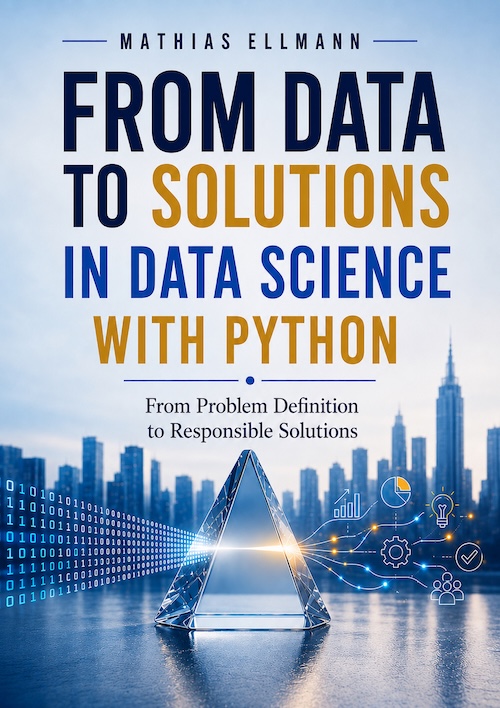
ISBN: 978-3-695-26298-4
Data Science is often reduced to algorithms, models, and tools. Yet real value does not arise from data alone. It arises from the ability to turn data into reliable insights, well-founded decisions, and responsible solutions.
From Data to Solutions in Data Science with Python explains how Data Science projects can begin with a clearly defined problem, follow a systematic analytical process, and lead to practical, traceable, and responsible solutions.
The book covers problem definition, project questions, data sources, data provenance, data quality, ETL, feature engineering, model development, evaluation metrics, uncertainty, deployment, monitoring, communication, and Python as a tool for reproducible Data Science processes.
The book is intended for students, educators, Data Science beginners, Python learners, Data Analysts, Data Scientists, Machine Learning Engineers, Software Developers, Business Analysts, Product Managers, managers, decision-makers, project teams, IT consultants, and anyone who wants to understand Data Science not merely as model development, but as a systematic process for solving real-world problems.
From Data to Solutions in Data Science with Python is available as an eBook from Amazon Kindle, Apple Books, Thalia, Hugendubel, and eBook.de.
Why successful Data Science does not begin with an algorithm, but with a clearly understood problem, appropriate objectives, and relevant questions.
How data arise, why provenance matters, how raw data should be examined, and how completeness, accuracy, consistency, timeliness, uniqueness, and relevance affect a project.
How data are extracted, cleaned, transformed, combined, documented, and made available through reproducible Python processes.
How meaningful variables are developed from raw data, why features contain domain assumptions, and how feature quality, stability, and data leakage can be evaluated.
How questions are translated into modeling tasks, why baselines matter, and how alternative models and hyperparameters can be compared systematically.
Accuracy, precision, recall, F1 score, ROC-AUC, confusion matrices, decision thresholds, and the relationship between metrics, project objectives, and practical decisions.
How data risks, model risks, technical risks, ethical risks, uncertainty, and competing objectives can be made visible and considered in responsible decisions.
How experiments, features, models, and pipelines can be documented, versioned, deployed, monitored, and improved over time.
How analytical results can be translated into clear recommendations, decision briefs, understandable visualizations, and responsible action.
An English-language presentation accompanying From Data to Solutions in Data Science with Python is currently being prepared.
The presentation will provide a concise introduction to the book's central path: from problem definition and data acquisition through data quality, ETL, feature engineering, model development, evaluation, deployment, monitoring, communication, and responsible solutions.
Once available, the presentation will be viewable directly in the browser and downloadable as a PDF.
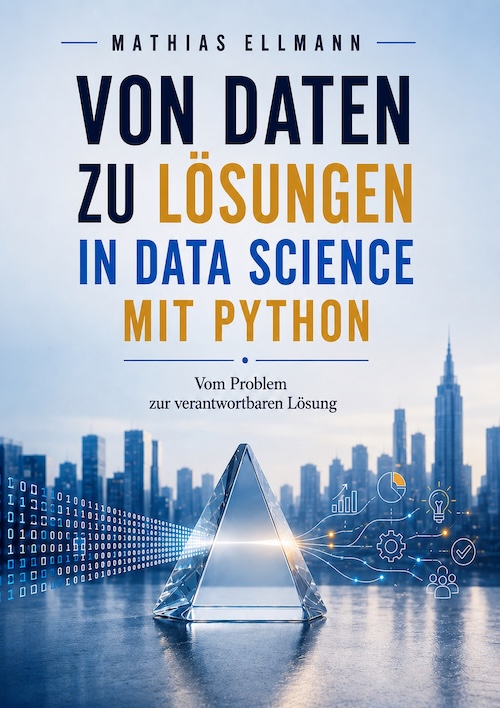
The German edition of From Data to Solutions in Data Science with Python: a practical book about problem definition, data quality, ETL, feature engineering, modeling, evaluation, deployment, monitoring, and responsible solutions.
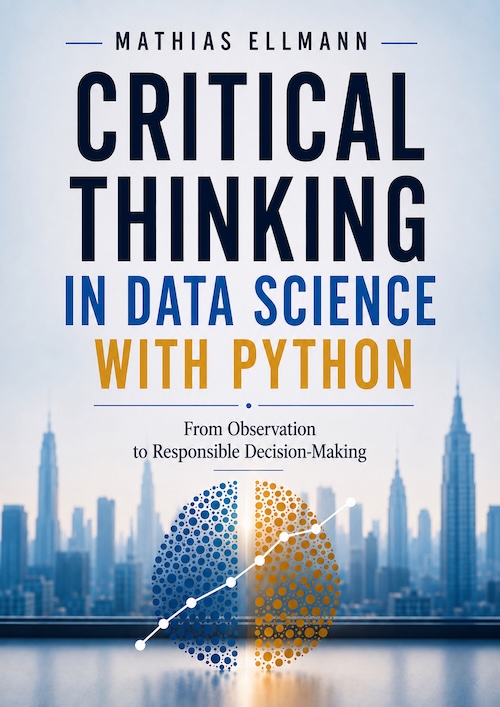
A book about observation, interpretation, hypotheses, reasoning, uncertainty, models, fairness, responsibility, communication, and Python as a tool for critical data analysis.
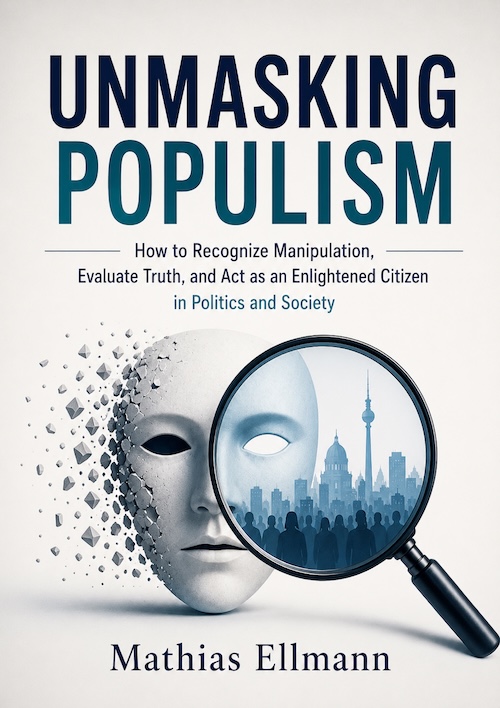
A book about recognizing manipulation, evaluating truth, examining political communication, and strengthening democratic judgment.
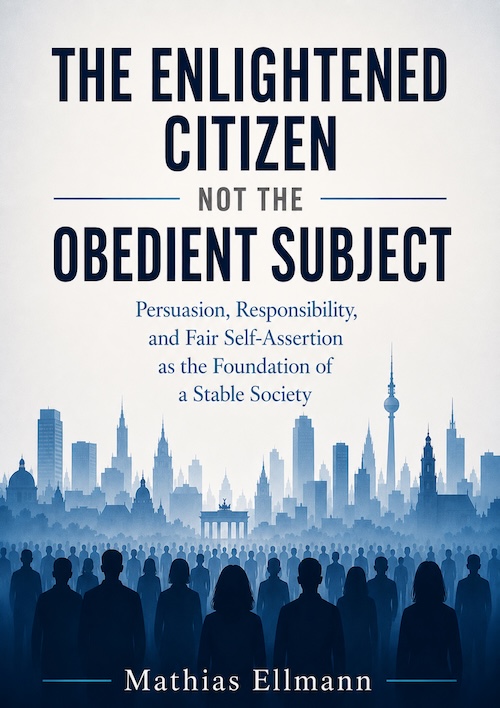
A book about persuasion, responsibility, Fair Self-Assertion, legitimate power, democracy, and stable social order.
The book presents Data Science as a systematic problem-solving discipline. It explains how problems can be translated into questions, data processes, features, models, evaluations, decisions, implementations, and responsible solutions.
Yes. The book is suitable for students, educators, Data Science beginners, Python learners, practitioners, and decision-makers who want to understand Data Science as a complete problem-solving process.
The book covers problem definition, data sources, data provenance, data quality, data cleaning, ETL, feature engineering, model development, model evaluation, deployment, monitoring, data drift, communication, and responsible implementation.
Yes. It covers raw data, missing values, duplicates, outliers, data types, category standardization, ETL processes, transformations, reproducibility, and data preparation with Python.
Yes. It explains how features are developed from raw data, how feature ideas are evaluated, how features are created with Python, and how data leakage and feature risks can be identified.
Yes. It covers the path from a question to a model, baselines, train-test splits, model training with Scikit-Learn, model alternatives, hyperparameters, pipelines, and reproducibility.
Yes. It explains accuracy, precision, recall, F1 score, ROC-AUC, confusion matrices, decision thresholds, model comparison, trade-offs, risks, and uncertainty.
Yes. It covers the path from notebooks to pipelines, experiment traceability, model versioning, monitoring, data drift, concept drift, retraining, and continuous improvement.
The book is intended for students, educators, Python learners, Data Analysts, Data Scientists, Machine Learning Engineers, Software Developers, Business Analysts, managers, project teams, and decision-makers.
The eBook is available from Amazon Kindle, Apple Books, Thalia, Hugendubel, and eBook.de.
The content can be adapted as a lecture, workshop, or moderated practical format for universities, companies, educational institutions, Data Science teams, managers, project teams, and organizations.
The focus is on practical questions: How should a Data Science problem be defined? Which data are suitable? How can data quality and risks be assessed? How should models and metrics be evaluated? How can analytical results be transformed into responsible and sustainable solutions?
Translate real-world challenges into clear questions, objectives, analytical tasks, and decision requirements.
Examine data provenance, data quality, ETL, transformations, feature engineering, reproducibility, and traceability.
Evaluate models, metrics, alternatives, risks, deployment, monitoring, communication, and human responsibility.
For enquiries about books, lectures, training programmes, workshops, or professional collaboration: