Machine Learning as Decision Support
Why machine learning does not end with predictions and only becomes practically valuable when placed within a decision-making context.
From Models to Responsible Decision-Making
by Mathias Ellmann
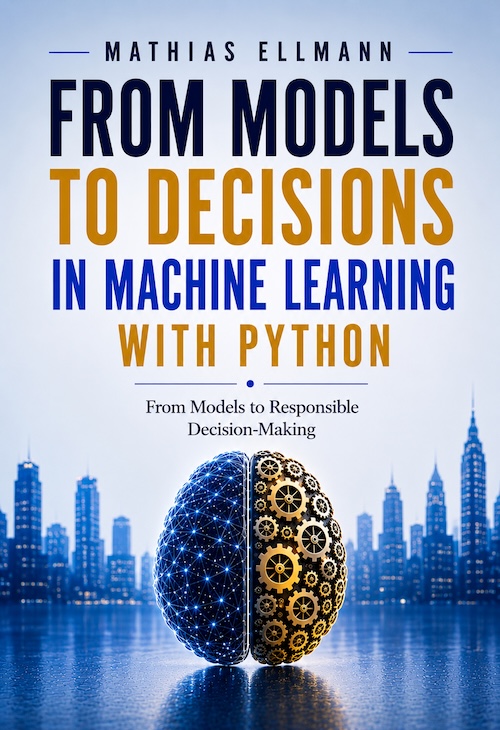
Machine learning is often reduced to algorithms, models, and metrics. Yet practical value does not arise from a trained model alone. It arises from the ability to turn predictions into transparent, well-founded, and responsible decisions.
From Models to Decisions in Machine Learning with Python explains how machine learning projects can move from problems, data, models, metrics, and uncertainty to responsible decision-making.
The book covers problem understanding, target variables, training data, features, baselines, model types, Scikit-Learn, model evaluation, accuracy, precision, recall, F1 score, ROC AUC, overfitting, underfitting, feature importance, uncertainty, risks, fairness, trade-offs, monitoring, and human judgment.
The book is intended for students, educators, Python learners, machine learning beginners, Data Analysts, Data Scientists, Machine Learning Engineers, software developers, Business Analysts, product managers, managers, decision-makers, project teams, and anyone who wants to understand machine learning not merely as model training, but as responsible decision support.
From Models to Decisions in Machine Learning with Python is available as an eBook from Amazon Kindle, Apple Books, and Thalia.
| ISBN | 978-3-695-26312-7 |
|---|---|
| Format | eBook |
Why machine learning does not end with predictions and only becomes practically valuable when placed within a decision-making context.
Why target variables, data provenance, representativeness, historical context, and bias determine what a model can meaningfully learn.
How typical machine learning workflows can be constructed, trained, evaluated, and interpreted with Scikit-Learn.
Why accuracy, precision, recall, F1 score, ROC AUC, confusion matrices, and regression metrics must be interpreted within their practical context.
How model limitations, error consequences, fairness, explainability, uncertainty, and competing objectives can be identified and assessed.
How model results can be translated into understandable recommendations, accountable decisions, and responsible solutions.
An English-language presentation accompanying From Models to Decisions in Machine Learning with Python is currently being prepared.
The presentation will provide a concise introduction to the central path of the book: from problem understanding, data, and model development to evaluation, uncertainty, trade-offs, monitoring, and responsible decision-making.
Once available, the presentation will be viewable directly in the browser and downloadable as a PDF.
Yes. The book explains machine learning with Python and shows how models can be developed with Scikit-Learn, evaluated critically, and translated into understandable and responsible decisions.
Yes. The book is suitable for machine learning beginners, Python learners, students, educators, and professionals who want to understand machine learning within a broader decision-making context.
Yes. It explains typical machine learning workflows with Scikit-Learn, including training data, features, train-test splits, cross-validation, model training, predictions, and model evaluation.
The book covers classification, regression, clustering, anomaly detection, recommendation systems, decision trees, random forests, gradient boosting, and neural networks.
Yes. It explains accuracy, precision, recall, F1 score, ROC AUC, confusion matrices, and regression metrics such as MAE, MSE, RMSE, and R squared.
Machine learning models produce predictions, scores, or probabilities rather than complete decisions. Responsible decisions also require context, objectives, uncertainty, risks, fairness, explainability, trade-offs, and human judgment.
The book is intended for students, educators, Python learners, machine learning beginners, Data Analysts, Data Scientists, Machine Learning Engineers, software developers, Business Analysts, product managers, managers, and decision-makers.
Yes. Model evaluation is a central topic, including metrics, baselines, train-test splits, cross-validation, overfitting, underfitting, feature importance, uncertainty, risks, and trade-offs.
Yes. It discusses responsibility, fairness, explainability, risks, competing objectives, monitoring, and the responsible integration of machine learning into real-world decisions.
The eBook is available from Amazon Kindle, Apple Books, and Thalia.
The content can be adapted as a lecture, workshop, or moderated practical format for universities, companies, educational institutions, machine learning teams, Data Science teams, managers, project teams, and organizations.
The focus is on practical questions: What can a machine learning model actually provide? How should training data, target variables, metrics, uncertainty, and risks be evaluated? How can predictions be translated into transparent and responsible decisions?
Translate real-world challenges into clear questions, target variables, data requirements, and decision contexts.
Examine baselines, model alternatives, evaluation metrics, overfitting, uncertainty, explainability, and practical limitations.
Make risks, trade-offs, fairness, monitoring requirements, and human responsibility explicit within machine learning projects.