Large jumps
01 · Term and function
What is Grand Jeté?
A large jump with clear forward or spatial travel and widely opened legs in flight; takeoff and landing are organized through plié.
prepare · take off · travel · open · land
travel, height, airborne leg line, and controlled landing
Interactive schematic movement analysis with its own movement logic
02 · Technical execution
What matters in Grand Jeté
The preparation establishes direction, momentum, and the takeoff leg.
The push from the floor creates height and/or travel without sacrificing alignment.
The legs open into the characteristic airborne shape with active feet.
Torso and arms organize the trajectory and spatial orientation.
The landing absorbs force through the foot and plié and continues the phrase safely.
Body awareness: Notice which part of the body supports the movement, which part travels, and where the movement can remain clear without forcing range, turnout, speed, or height.
03 · Movement phases
Grand Jeté step by step
Organize weight, direction, feet, torso, and focus for the movement that follows.
Organize weight, direction, feet, torso, and focus for the movement that follows.
Use the supporting foot and leg to create a clear upward or traveling impulse while maintaining alignment.
Maintain the characteristic leg and torso organization while the body is airborne.
Receive the floor through the foot and plié, keeping the leg axis controlled and the next movement available.
Use the supporting foot and leg to create a clear upward or traveling impulse while maintaining alignment.
04 · For children and beginners
Observe and explore safely
Practice the preparation and landing before adding speed, height, beats, or rotation. Keep the jump small enough to land quietly and with control.
Which foot or leg is supporting you right now, and which part is moving?
Can you keep the direction and supporting organization clear while the movement changes?
Work only as large, fast, or high as you can control comfortably and without pain.
05 · Teaching and feedback
What teachers and learners can observe
Takeoff, leg organization, foot articulation, axis, and controlled landing.
Appropriate force in push-off and controlled absorption on landing.
Usable range without visible compensation in the pelvis or torso.
Timing, duration, flight rhythm, and intentional accent.
Clear direction, focus, beginning, and finish.
Maximum height, speed, turnout, or range is not a meaningful criterion on its own. What matters is controlled, physically coherent execution.
06 · Choreographic use
How the effect of Grand Jeté can change
A technical movement is shaped on stage by time, space, form, gaze, and relationship. These variables change perception without assigning a fixed psychological meaning to the movement.
Height and distance determine the visual scale of the action.
A direct, diagonal, circular, or crossing path changes the dramatic use of space.
Suspension, acceleration, or delayed landing changes the perceived weight of the jump.
A large jump may approach, cross, avoid, follow, or answer another person.
07 · Feeling, need, and relationship
Possible readings — not fixed meanings
Feelings and needs are not derived from Grand Jeté itself. They are possible readings of a specific situation. Feeling, need, intention, and movement operation therefore remain separate.
Possible feelings: concentration, composure. Possible needs: orientation, stability. Possible intentions: prepare, organize, sustain a state.
Possible feelings: determination, tension. Possible needs: clarity, effectiveness. Possible intentions: set an impulse, mark a direction.
Possible feelings: connection, caution, resistance, or curiosity — depending on context. Possible needs: cooperation, autonomy, respect, or orientation. Possible intentions: respond, follow, avoid, support, or mark a boundary.
Choreographic guiding question: How does one person’s action change another person’s possibilities for action?
08 · Continue learning
From Grand Jeté to related movements
Chassé means “chased.” The movement combines opening, drawing the other foot in, and continuing again into a clear traveling step.
Glissade combines plié, brushing, a small flight phase, and closing into a usually connecting traveling jump.
Grand battement is a large leg action. The working leg leaves the floor with the knee extended, reaches a high line, and returns with control.
A small jumping weight transfer: one leg brushes out, the body leaves the floor and lands on the brushing leg while the other leg becomes free.
An arrow-like jump in which the legs are driven energetically one after the other through the flight phase, creating a clear spatial impulse.
A large cat-like jump, often with a developed front leg and a widely opened back leg; naming overlaps with Grand pas de chat depending on the school.
A large turning jump combines travel, leg change, and rotation; exact terminology overlaps with Jeté entrelacé in some schools.
A large turning and changing jump in which the legs change their spatial relationship during flight and the body changes direction.
Additional professional background
Books on learning and body awareness
The movement lexicon complements two book projects by Mathias Ellmann: The Ballet Teaching Tree for reflective, healthy learning and Leni and Oscar and the Secret of the Ballet Tree for younger readers.
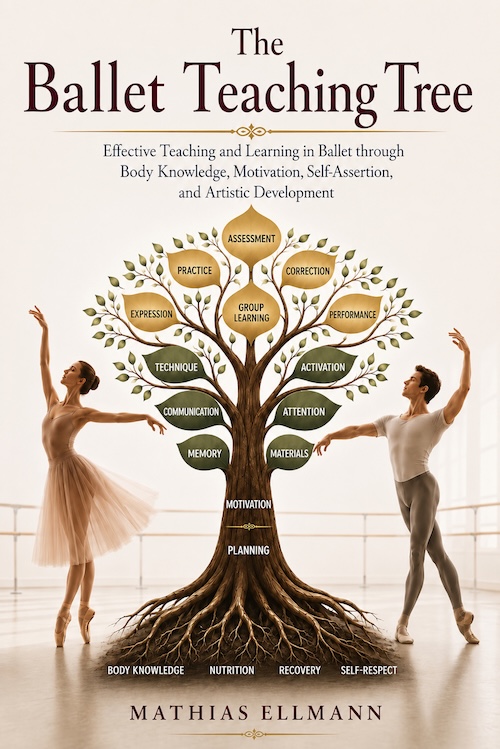
The Ballet Teaching Tree
A model for healthy, reflective, artistically oriented ballet learning — with body awareness, motivation, self-respect, and long-term development.
About The Ballet Teaching Tree
Leni and Oscar and the Secret of the Ballet Tree
A story about body awareness, courage, learning, and the joy of development for younger readers.
About the children’s bookConcept · Ballet knowledge · Choreography
Mathias Ellmann

Mathias Ellmann develops the Ballet Movement Lexicon as a connection between classical ballet technique, body awareness, learning, and choreographic application.
Movements are first described in observable terms. Choreographic variables, relationship, and possible dramaturgical readings are added only afterwards.
In the contemporary ballet projects, classical ballet technique is used as a precise language of human relationships. The central question is: How does one person’s action change another person’s possibilities for action?