Social order
Persuasion instead of mere submission
The first book contrasts coercion and obedience with an order based on comprehensible reasons, responsible consent and limited power.

Books · Democracy · Democratic Maturity · Political Communication
Two independent books examine the conditions of democratic maturity and one of its central threats: manipulative, reductive political communication that shields itself from criticism.
A stable democracy needs more than formal freedom. It needs people who examine information, tolerate disagreement, represent their interests fairly and accept responsibility for their judgments and actions.
A political and philosophical educational project
The two titles are independent books. In content, however, they form a connected educational and social project. “The Enlightened Citizen, Not the Obedient Subject” asks how stable social order can emerge through persuasion, responsibility and fair self-assertion. “Unmasking Populism” examines how political communication can weaken judgment through simplification, emotionalization, enemy images, repetition and insulation from criticism.
Their shared starting point is this: democracy does not live by elections, rights and institutions alone. It also depends on people who distinguish facts from interpretations, clarify goals, examine arguments, consider alternatives and take responsibility for their decisions.
Make concerns, needs, fears and interests visible.
Examine what should be achieved and which limits apply.
Recognize emotions, initial interpretations and possible biases.
Assess sources, arguments, alternatives and consequences.
Agree, object or act on the basis of reasons.
Thematic connection
Social order
The first book contrasts coercion and obedience with an order based on comprehensible reasons, responsible consent and limited power.
Judgment
Democratic maturity means not merely adopting claims, but examining sources, goals, reasons, alternatives and likely consequences.
Political communication
The populism book describes a typical sequence of problem simplification, emotionalization, enemy-image formation, simplified solutions, repetition and insulation from criticism.
Democratic action
The aim is not counter-propaganda. It is careful examination, de-escalating communication, fair self-assertion and action that remains compatible with the rule of law.
The two books
Each book can be read independently. Together they connect political philosophy, democratic education, psychology, argument analysis, decision theory and fair self-assertion.
Social order · Persuasion · Responsibility
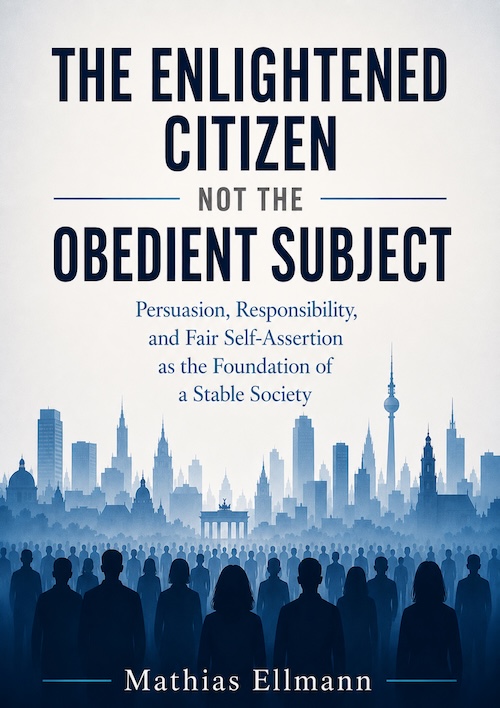
Persuasion, responsibility and fair self-assertion as foundations of stable social order
The book examines whether social stability should be based primarily on coercion and obedience or on persuasion and responsible consent. It connects questions of autonomy, legitimate power, communication, responsibility and democratic culture.
Populism · Manipulation · Argument Analysis · Democracy
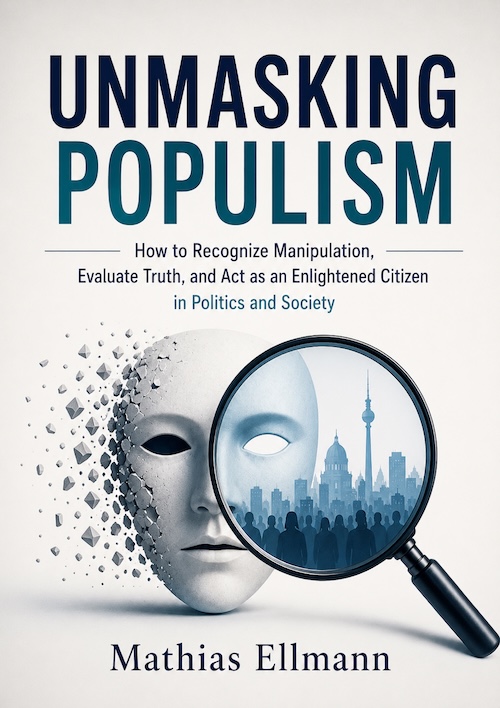
How to recognize manipulation, test truth and act as a responsible citizen in politics and society
The book examines populism as a form of political communication. It combines philosophical foundations, psychological influence, cognitive biases, argumentative fallacies and the PrOACT decision framework developed by Hammond, Keeney and Raiffa. In the book, this framework is used to examine political claims, goals, alternatives and consequences in a structured way.
Models for analysis and decision-making
Complex problem → problem simplification → emotionalization → personalization and enemy-image formation → simplified solutions → repetition and reinforcement → insulation from criticism
Motivation → goal → spontaneous processing → logical processing → conclusion
The underlying five-stage model goes back to Correll. Mathias Ellmann adopts its basic structure and applies it to the context of democratic maturity. The emphasis is placed on reasoned consent, responsible action and fair self-assertion.
PrOACT is a framework for the structured analysis of decisions. In the context of political judgment, it serves as a guide for examining goals, alternatives, consequences and trade-offs systematically.
These models are aids to orientation. They do not replace a complete analysis of specific political cases. Individual stages may overlap, carry different weight or be intensified by institutional, social and media-related conditions.
Two forms of order and communication
Judgment under influence
Is the problem described with sufficient precision, or is its complexity reduced to a single cause?
Which political, social or personal goals are being pursued, and are they stated openly?
Which statements can be checked, and which rest on interpretation, certainty, assumption or mere repetition?
What role do fear, outrage, belonging, grievance or hope play in the effect of the message?
Are different courses of action examined, or is one solution presented as having no alternative?
Which effects, risks, conflicts of goals and burdens arise for different groups?
Shared competencies
Examine arguments, sources, fallacies, assumptions and counterarguments in a transparent way.
Notice one's own emotions, group loyalties, interests and cognitive biases.
Weigh problems, goals, alternatives, consequences and trade-offs in a structured manner.
Represent one's own interests clearly without violating the rights of others, and take responsibility for the consequences.
Allow different perspectives without abandoning critical examination of reasons and consequences.
Argue objectively, de-escalate conflict and distinguish between clarification, persuasion and principled boundaries.
Do not agree merely because of emotion or pressure, but on the basis of reasons and an awareness of likely consequences.
Understand education, the public sphere, law, media and democratic oversight as conditions of individual maturity.
Audiences
Civil society
For people who want to examine political claims independently, tolerate disagreement and act responsibly.
Education
As a basis for political education, philosophy, argumentation, media literacy and democratic learning.
Media and communication
For analyzing framing, enemy images, simplifications, repetition, sources and public escalation.
Politics and administration
For transparent justification, clear goals, participation and the exercise of power within the limits of the rule of law.
Organizations
For reflective communication, conflict management, responsibility and fair decision-making processes.
Democratic practice
For workshops and discussions on manipulation, opinion formation, self-assertion and democratic participation.
Scope and limitations
Not every simplification, emotional appeal or form of criticism is automatically populist. What matters is the overall structure: Are facts examined, counterarguments permitted and different perspectives acknowledged, or is a closed interpretive system built that shields itself from correction?
Frequently asked questions
No. The two titles are independent books. In content, however, they form a connected political and philosophical educational project: the first examines the conditions of democratic maturity, while the second analyzes populist communication as a threat to that maturity.
“The Enlightened Citizen, Not the Obedient Subject” develops a model of responsible persuasion, consent and fair self-assertion. “Unmasking Populism” shows how political communication can become manipulative through simplification, emotionalization, enemy images, repetition and insulation from criticism.
The underlying model was developed by Correll. Mathias Ellmann adopts its basic structure and develops it further for the context of democratic maturity. The five stages — motivation, goal, spontaneous processing, logical processing and conclusion — describe a path from an initial concern through examination and reflection to a responsible decision.
The books describe problem simplification, emotionalization, personalization and enemy-image formation, simplified solutions, repetition and reinforcement, and insulation from criticism.
No. The books distinguish legitimate criticism from manipulative and anti-pluralist communication. What matters is not sharpness or emotion alone, but the structure of the argument, the quality of its justification, its treatment of counterarguments and its claim to truth.
No. The books provide philosophical, communicative and decision-theoretical models. They do not replace legal advice, constitutional review or a complete empirical analysis of specific political cases.
For workshops, seminars, teaching, professional discussions or questions about individual books, you can make contact by telephone or email. Content, audience, duration and fees are agreed in advance.
Please send sensitive or confidential documents only through a secure transmission method agreed in advance. Time-critical deadlines are accepted only after explicit confirmation.