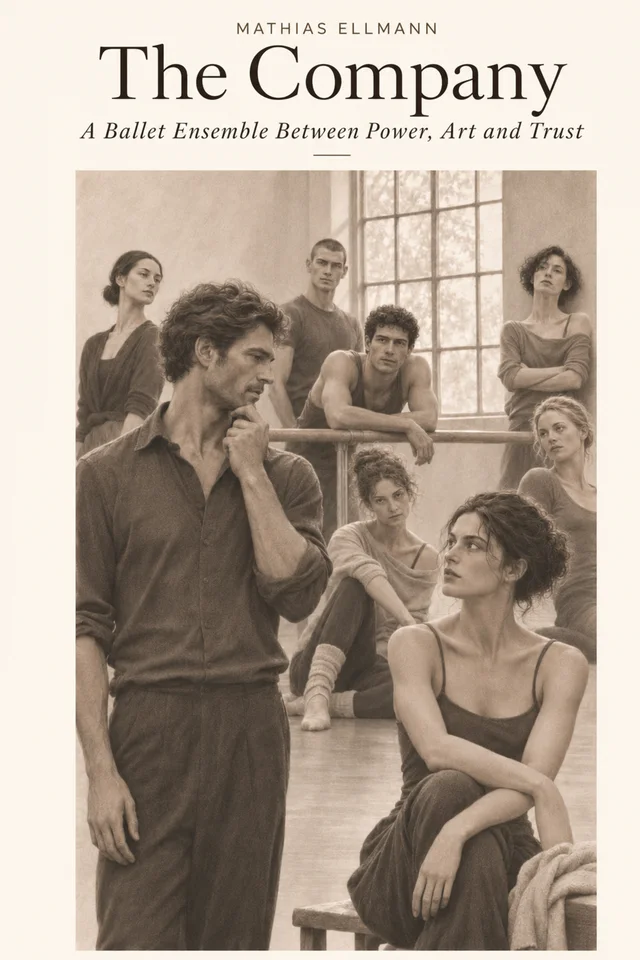
The missing chair
Chapter 1. The First Morning · Chapter 9. Who Wrote This?
On the first morning Mara Levin still knows every uneven patch in the floor. The mirrors, barres and piano are where they have always been. One missing chair is enough to change how she reads the room. Viktor Saran used to watch class from that chair. He remains a point of reference long after Julian Marot has taken over as director.
The opening puts the reader close to Mara. We can notice what she notices, and at first we have little more than her interpretation to go on. Later the narrative moves closer to other people. The company’s written statement gathers concerns for those who drafted it. Julian receives it as a document with fourteen names on his desk. The shift in vantage point changes the weight of the same event.
What two counts can change
Chapter 2. Not Seen
The second group enters two counts earlier in the canon. Space opens up sooner and the movement feels less inescapable. Mara registers both effects. The precision of her objection comes from her ability to describe what the change gains and what it costs. The detail gives the company something concrete to argue about.
There is a time lag in the telling as well. Julian has watched a rehearsal video. Tomas relays the instruction in the studio. Eva can pass Mara’s response back to him. Several people and several moments intervene between observation, instruction and reply. Being seen in the studio and having one’s observation shape the next run are separate matters.
How a rumour acquires authority
Chapter 6. About Him · Chapter 8. We Have to Do Something
Eva starts by describing a review of whether three older productions can be accommodated next season. The number three survives almost intact as the story travels. A review becomes an intention, and older productions become Saran works. A series of short sentences at the end of Chapter 6 traces the changes. Each version makes it a little harder to recover the thing that could actually be checked.
The story makes sense to people already afraid of a break with Saran’s era. Leandro’s invitation to meet without management reveals a related tension. A conversation among colleagues can make it easier to speak. The boundary around that conversation can also harden into a line between two camps.
Eight bars and a name on the schedule
Chapter 10. Resistance
In the old ending the central figure moves backwards, raises an arm and stops as the group continues. In the new version the figure moves forwards with the others. Trying both versions in front of the mirror, Mara sees what the new ending can do. That recognition gives the scene its friction. She can hold on to her objection and find something worthwhile in the change.
The morning after she speaks up, her name is missing from the schedule for the working rehearsal. Julian wants to test the version with dancers less rooted in the old one. He can explain that choice in artistic terms. Mara has a further question. How can she raise a professional objection if the objection itself becomes evidence of her attachment to the past? The schedule gives that question a material form.
What can be agreed at the table
Chapter 12. The Table
Miriam Feld gives people a way to state an observation, an interpretation and a request so each can be heard on its own terms. Noa asks to hear what became of the company’s input. Julian keeps responsibility for artistic decisions. Mara asks to hear about a change affecting her before it appears on a schedule. The scene distributes responsibility among several people.
Four agreements make a future test possible. People should hear directly about major individual changes before publication where possible. The status of casting decisions should be clear. A regular meeting leaves room for questions. When speaking directly is difficult, a protected route to a third person remains available. Miriam writes in a review after six weeks. The everyday work will show what holds.
The work behind opening night
Chapter 13. It's Working · Chapter 14. Opening Night · Chapter 15. The Proof
For the transition from a duet to the larger group, Noa proposes a late entrance. Leandro imagines a cut and a change in the lighting. Felix and Elisa put forward different ways of using the space. Julian lets them try alternatives and points out technical limits. The scene shows how many distinct observations can feed a single choreographic decision.
Just before opening night, the lighting crew is still working from the previous sequence. Julian speaks sharply, then apologises and asks what they need. They need time with the stage clear. Afterwards the review credits Marot with a successful new beginning. A pencilled remark on the noticeboard draws attention back to the others. The novel asks who receives public credit for work made together.
When an agreement has to cost time
Chapter 16. No Time · Chapter 17. That's What We Agreed On
The company meeting after opening night is postponed. A replacement date is promised, then fails to materialise. When the next conflict comes, Mara again learns from a schedule about a change that affects her. The pressures are recognisable ones, including meetings, deadlines and responsibilities. Without time set aside, an agreement can quietly disappear from everyday work.
Eva later records the failure in the process without naming anyone. Future notices about significant individual changes will be cleared for publication once the person has been told directly or the reason for an exception has been recorded. A pledge becomes a step people can check. Whether it keeps being followed is left open.
The open ending
Chapter 18. I'll Take Care of It
Tomas comes to see how stepping in quickly can spare both Noa and Julian conversations they could have themselves. Eva’s idea of open office hours gives such conversations a place in the working week. When people begin to turn up, something small has changed. They can knock without having to catch the right moment between rehearsals.
Eva’s last line turns a recurring phrase about taking care of things on its head. She has helped make the conversation possible and leaves people to have it. The open door answers the missing chair at the beginning. The novel ends with a concrete attempt to share responsibility. How far it will alter the company’s established hierarchy remains to be seen.