Judgment
Recognizing self-deception and cognitive errors
Cognitive biases, illusions of control, groupthink, and sunk-cost dynamics influence which information a startup notices and which information it ignores.

Books · Startup Psychology · Organization · Sales
Two independent books examine why promising ideas and technically strong products can fail because of self-deception, power dynamics, poor decisions, market blindness, and insufficient customer trust.
Good ideas and good products are not enough. Startups need contact with reality, constructive disagreement, psychological safety, clear accountability, reliable market validation, and trust.
Thematic connection
The two titles are independent books. Together, they form a closely connected analytical and practical project: the first book examines why startups can lose clarity, accountability, communication quality, and decision-making capacity internally. The second shows how related patterns become visible in sales, market validation, and customer relationships.
The shared starting point is simple: technical quality, capital, and commitment do not automatically protect a startup from harmful developments. What matters is whether facts are separated from interpretations, counterarguments are allowed, responsibility is clear, and market feedback is treated as a learning signal.
Make assumptions and emotional attachments visible.
Recognize confirmation bias and selective interpretation.
Protect disagreement, clear roles, and accountability.
Test behavior and willingness to pay instead of false signals.
Build credibility through listening, transparency, and consistency.
Review, correct, and explain decisions.
Relevance for founders and practitioners
Failure rarely begins with an empty bank account or missing sales results. It often develops earlier: assumptions are no longer tested, criticism becomes personal, accountability becomes unclear, and positive feedback is mistaken for reliable demand.
Judgment
Cognitive biases, illusions of control, groupthink, and sunk-cost dynamics influence which information a startup notices and which information it ignores.
Power and organization
Concentrated power, unclear roles, and fear-driven communication can prevent warning signs from being voiced and addressed in time.
Market validation
Attention, politeness, registrations, or pilot projects are not sufficient evidence of willingness to pay, repeated purchases, or Product-Market Fit.
Trust
Sales is not merely a revenue function. It reveals whether customers recognize a real problem, trust a solution, and are willing to change behavior or allocate budget.
The two startup books
Each book can be read independently. Together, they describe two closely connected levels: the internal breakdown of a startup and the external loss of contact with customers and the market.
Startup Psychology · Power · Organization · Decisions

Why Great Ideas Die Because of People, Power, and Poor Decisions
The book examines startup failure as a psychological, communicative, ethical, and organizational process. Its focus includes sound judgment, cognitive biases, power, conflict, diffusion of responsibility, health, organizational culture, and decision architectures.
Startup Sales · Market Validation · Customer Psychology · Trust
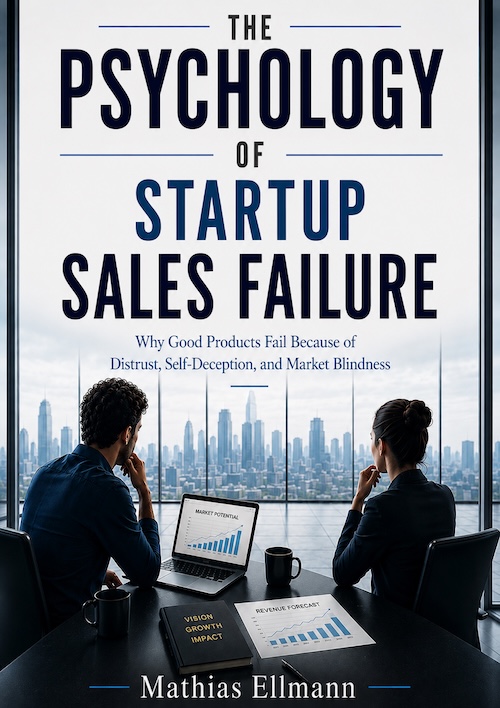
Why Good Products Fail Because of Distrust, Self-Deception, and Market Blindness
The book applies psychological and organizational perspectives to sales, market validation, Customer Discovery, and trust building. It understands sales as contact with market reality and as an early warning system for startups.
Two levels of the same problem
The books examine complex psychological, social, organizational, and economic relationships. They do not reduce startup failure to a single person or a single cause.
Target audiences
Founding
For people who want to examine their assumptions, leadership behavior, risk perception, and market decisions critically.
Teams and leadership
For clarifying roles, conflicts, power, accountability, psychological safety, and organizational learning.
Product
For distinguishing internal product assumptions from genuine customer problems, usage behavior, and market evidence.
Sales
For Customer Discovery, trust building, realistic market validation, and the avoidance of manipulative sales practices.
Funding and support
For evaluating decision quality, team dynamics, market readiness, learning capacity, and potential warning signs.
Teaching and learning
As a basis for seminars, workshops, and discussions about startup psychology, organization, market validation, and responsible sales.
Shared capabilities
Distinguish observable facts from interpretations, hopes, and narratives.
Reflect on confirmation bias, the illusion of control, groupthink, sunk-cost dynamics, and founder ego.
Examine problems, objectives, alternatives, consequences, and trade-offs in a structured way.
Design roles, responsibilities, escalation paths, and institutionalized counterarguments transparently.
Evaluate statements, behavior, willingness to pay, retention, and repeatable demand separately.
Develop customer relationships through listening, transparency, consistency, and credible communication.
Allow disagreement, warning signs, and uncertainty without turning them into blame or power struggles.
Correct decisions, use warning signals, and learn transparently from market and team feedback.
Orientation instead of a success formula
Is the startup solving a genuinely relevant problem, or mainly confirming its own product idea?
Which signals come from observable behavior, willingness to pay, usage, and retention?
Are objectives, alternatives, consequences, risks, and follow-up decisions transparent?
Can team members disagree, and are tasks, decisions, and consequences clearly assigned?
Does the sales organization understand customers and buying processes, or mainly defend a predetermined solution?
Are continuation, focus, pivot, partnership, restructuring, or an orderly withdrawal compared openly?
Scope and limitations
The books do not replace individual therapy, legal advice, tax advice, company restructuring, or specific investment decisions.
Frequently asked questions
No. The two titles are independent books. However, they form a closely connected analytical and practical project: the first examines internal startup breakdown, while the second explores the loss of market contact through failing sales processes.
Both books can be read independently. For a continuous learning path, The Psychology of Startup Failure can be read first, followed by The Psychology of Startup Sales Failure.
The books are intended for founders, startup teams, executives, product managers, sales leaders, investors, coaches, consultants, lecturers, students, and researchers.
No. The books also support prevention. They describe warning signs, cognitive errors, and problematic organizational patterns before they develop into economic or organizational breakdown.
Sales reveals whether a relevant customer problem, trust, and willingness to pay are actually present. Interest, politeness, or attention alone do not demonstrate reliable demand.
No. The books provide analytical frameworks, decision models, and practical orientation. They do not replace individual therapy, legal advice, tax advice, or company restructuring.
For workshops, seminars, lectures, professional discussions, or questions about individual books, you can get in touch by phone or email. Content, target group, duration, and fees are agreed in advance.
Please send sensitive or confidential documents only through a secure transmission method agreed in advance. Time-critical deadlines are only accepted when this has been expressly confirmed.